
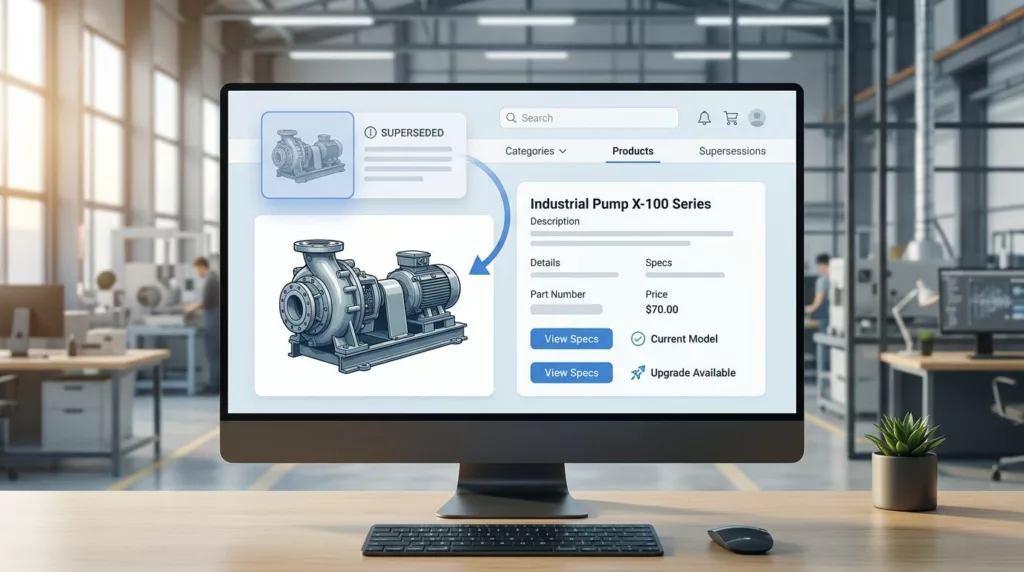
Industrial buyers do not have patience for guesswork. When a part number has changed, the page needs to communicate that information quickly, in plain language, and in the right location.
If that message is missing or buried, users often misorder components, waste valuable time on support calls, and lose trust in the digital catalog. Effective superseded part messaging ensures that users can verify a superseded part, identify the correct updated part number, and determine their next steps without having to hunt through technical documentation. Prioritizing clear part identification throughout the experience helps prevent procurement errors and keeps the supply chain moving smoothly.
Key Takeaways
- Provide Immediate Clarity: Place clear replacement notices near the top of the product detail page, ensuring buyers instantly see the legacy number and its direct replacement without having to scroll.
- Support Every User Journey: Integrate status messaging across search results, category pages, and cart screens to prevent misorders at every stage of the procurement process.
- Use Consistent, Actionable Copy: Adopt factual, non-warning language that explicitly states what has changed and the specific next step, such as whether a new part is a direct, backward-compatible replacement.
- Maintain Historical Data: Keep legacy part numbers visible in your catalog to aid search engine visibility and help customers who are using older, existing documentation or BOMs.
Why superseded part messaging matters on industrial product pages
On industrial sites, the part number is often the primary focus of the user. A maintenance tech may perform a part number search using an old SKU from a machine label. A procurement buyer may paste a line from an old BOM, or a distributor may receive a reorder request that still uses the legacy number.
That means the page has to do more than sell. It has to translate.
When a legacy part has a successor, the page should clarify whether the item is replaced, superseded, discontinued, or still valid. These statuses are often necessary due to regular manufacturer updates or a specific design change. If the message is vague, buyers are forced to guess. Guessing leads to wrong orders, delayed repairs, and extra back-and-forth with sales or support teams.
Strong replacement messaging also supports trust. Buyers know catalogs age, and they do not expect a product line to stay frozen forever. They do expect the site to keep up. If the page handles old and new identifiers clearly, the site becomes a reliable source of truth for ordering parts.
For product pages that still need a tighter hierarchy, UX-centric product page design gives a useful baseline for layout and clarity.
What the message has to say, and what it should not
A good superseded-part flow answers four questions right away.
- What was the old part number?
- What is the replacement part number?
- Is the new item among the available replacement parts, or does it require a different fit?
- What should I do next?
That is the minimum. Anything less invites confusion.
Legacy data can get messy fast when ERP, PLM, and catalog data drift apart. If your team relies on an outdated part numbering system, it is important to remember that rigid logic often creates more friction than it solves. Managing your internal supersession history is essential to ensure that your database remains accurate and useful for buyers navigating your catalog.
A few things should stay out of the message. Avoid vague labels like “obsolete” if you still sell a functional equivalent. Avoid “contact sales” when the correct part number is already known. Avoid burying fitment notes in long paragraphs. Buyers should not need to decode the page.
If a buyer cannot tell what to order in a few seconds, the page is not doing its job.
Where to place replacement details across the buying journey
Replacement messaging works best when it appears in more than one place. A single banner on the product detail page is not enough. Buyers meet the catalog in search, category pages, internal navigation, reorder lists, and the PDP itself.
The right message depends on the surface. Effective communication relies on clear fitment logic, ensuring users understand how a superseded part interacts with their existing equipment.
| Surface | What to show | Why it helps |
|---|---|---|
| Product detail page | Banner or callout with the legacy number, replacement part number, and direct fit note | Gives immediate clarity before the buyer scrolls |
| Search results | Status label next to the title, plus the new part number | Reduces dead-end clicks and speeds up triage |
| Category or navigation pages | Small badge or filter state for legacy items | Helps buyers compare current and older options |
| Cart and reorder screens | Alert when a superseded SKU enters the order flow | Prevents misorders at the final step |
The takeaway is simple. The page should answer the question in the layer where the question appears.
For the PDP itself, order the content by urgency. Put the replacement status near the title or price block. Put compatibility notes close to specs. Put deeper history lower on the page.
That structure matters because industrial buyers scan fast. They want the part status first, then proof, then details. If they need more context, the page can carry it, but the top of the page should stay clean.
UI copy patterns that reduce confusion
The best copy is short and factual. It does not sound like a warning label. It sounds like a helpful handoff.
Here are a few patterns that work well:
- This superseded part has been replaced by ABC-123.
- Legacy part number XYZ-900. Order ABC-123 instead.
- Direct replacement, direct fit, and same function.
- Superseded on 15 Aug 2024. Replacement part below.
- No longer sold. Use ABC-123 for new orders.
These lines work because they tell the buyer what changed and what to do next. If the replacement is not exact, say that too. A direct replacement is one thing. A substitute with different dimensions or materials is another.
The wording should also reflect risk. For a critical spare part, say whether the new part is fully backward-compatible. For an accessory or packaging change, say that the swap does not affect fit. That level of detail aids in accurate part identification, helping maintenance teams avoid second-guessing.
A useful pattern for the page header is this:
Superseded part: XYZ-900
Replacement: ABC-123
Status: Direct replacement
That structure is easy to scan and easy to copy into a PO, note, or maintenance record. It also keeps the old number visible, which matters for search and for people who still use legacy references.
If your catalog needs a place for edge cases, product page FAQ section design works well when fitment, shipping, or substitution questions keep showing up.
Procurement teams need more than a banner
Procurement buyers do not shop the way a casual visitor does. They compare part history, confirm approved alternates, and check whether the order will fit a purchase workflow. They also need granular data for part identification that they can move into spreadsheets, RFQs, and internal approval systems.
That means the page should support the work, not just the click.
Give procurement teams a visible cross-reference table when the part family has changed over time. Include the legacy part number, the new replacement, status, and any compatibility note. If multiple replacements exist, make the difference obvious. If stock is limited on the older SKU, say whether it can still ship or whether the new SKU is the only valid option.
Category pages and search results help here too. A buyer scanning a long list should see which items are current and which ones are legacy. That small cue saves time and prevents a line item from getting added by mistake.
Good procurement support also means search retention. Old identifiers should still resolve to a useful page, not a dead end. If the catalog drops legacy numbers too early, the team loses both traffic and confidence.
Common mistakes that weaken trust
Superseded part messaging breaks down in predictable ways.
- Hiding the message below long specs or tabs.
- Using a vague status like “discontinued” without a replacement path, which ultimately compromises catalog accuracy.
- Sending old and new part numbers to separate pages with no clear bridge.
- Changing the wording between search results, category pages, and PDPs.
- Removing the legacy part number from on-page copy, which hurts findability.
Each of these mistakes adds friction. Together, they turn a simple replacement into a support ticket.
The SEO cost is real as well. Legacy part numbers often keep earning searches long after the physical part changes. If the page no longer mentions that number, it becomes harder for buyers to land on the right record. If it mentions the part number but never states the successor, the site attracts traffic and then stalls it.
Search engines and buyers both like clear signals. Put the old number in the visible content. Keep the replacement number in the title or lead block where it makes sense. Use the same phrasing across the catalog so the page feels stable, as this consistency is a standard expected by original equipment manufacturers and the engineers who rely on them.
How manufacturers, distributors, and aftermarket catalogs should handle it
Different sellers need different rules.
Manufacturers
Manufacturers own the source of truth. Their pages should show the engineering change, the successor component, and any documentation that explains the switch. When a specific OEM part number has a direct replacement, the page should clearly state the change. When the part number supersession affects fit, material, compliance, or service life, those details belong close to the status line.
Manufacturers also have the best chance to keep replacement history clean. That history should help field teams and account managers answer questions without digging through old emails.
Distributors
Distributors need speed and inventory truth. Their job is to guide buyers to the correct purchasable item, while keeping substitution rules easy to understand. If they still have stock on a superseded part, they should say whether it can ship and how long it will remain available.
For distributors, the risk is mixed messaging. If one branch says replaced and another says available, buyers lose confidence fast. A consistent page template helps.
Aftermarket catalogs
Aftermarket catalogs often deal with machine models, serial ranges, and fitment by application. That makes the page more complex, because the part number alone may not be enough. These pages need stronger compatibility notes, including reliable interchange data, and better browse paths for legacy numbers.
In this setting, superseded part messaging should sit alongside machine fitment data. Buyers should be able to see which models the old part covered, which models the new part covers, and where the difference starts. By utilizing ACES-compliant data structures or offering a VIN lookup tool for accurate vehicle identification, catalogs provide the necessary context to protect the sale and reduce returns when replacement history becomes messy.
Frequently Asked Questions
Why should I display legacy part numbers if the product has been replaced?
Industrial buyers often search using older part numbers from machine labels or existing bills of materials. Retaining these numbers on the page ensures your site remains a reliable source of truth, improves SEO, and prevents the user from hitting a dead end.
How much detail should I include in the replacement notice?
The message must be concise but comprehensive enough to answer four key questions: what the old number is, what the replacement number is, if the fit is compatible, and what the buyer should do next. Avoid burying critical fitment notes in long paragraphs or using vague labels like “obsolete.”
Where is the best place to display superseded part information?
While the product detail page is the most important location, information should also appear in search results, category pages, and the final checkout or reorder screen. This multi-layered approach ensures the buyer receives the necessary guidance exactly when and where they need to make a decision.
Conclusion
Clear superseded part messaging turns a broken path into a useful one. It gives buyers the old number, the new number, and the action they should take next whenever they encounter a superseded part.
When that same message shows up in search results, category pages, and product detail pages, the catalog feels trustworthy. It also cuts misorders, supports procurement teams, and keeps replacement traffic from slipping away.
The simplest test is still the best one. Can a buyer find the legacy part, understand the replacement, and complete the process of ordering parts in a few seconds? If the answer is yes, the page is doing real work.