

An ecommerce testing backlog can hold 40 ideas and still produce no clear next experiment. A practical A/B test prioritization method helps a small team choose work that can improve revenue, reduce friction, or answer an important customer question.
The score won’t predict a winner. It will make tradeoffs visible when engineering, design, marketing, product, and merchandising all want different work shipped first. Start by ranking the customer problem, the evidence behind it, and the learning the test can produce.
Why ecommerce teams need a testing framework
Most backlogs mix serious customer problems with personal preferences. A merchandising lead may want a new product card, while analytics shows that payment errors are costing more completed orders. Without a shared method, the loudest request often wins.
A useful framework gives every idea the same basic review. It also keeps a test backlog connected to business goals instead of treating experimentation as a collection of isolated page tweaks.
Prioritize the problem before the variation
Begin with the problem statement, not the proposed design.
“Add a sticky button” is an idea. “Mobile shoppers lose access to the primary action after selecting a variant” describes a problem that can be investigated.
The second version leaves room for more than one solution. It might lead to a sticky button, a shorter product page, a better variant selector, or a change to page layout. This protects the team from approving a specific design before it understands the customer friction.
A strong backlog item includes:
- The affected audience and journey step.
- The observed problem or business opportunity.
- The proposed hypothesis.
- The primary metric and likely guardrails.
- The estimated design and engineering effort.
Separate evidence from enthusiasm
A test supported by repeated analytics patterns should usually outrank a test based on one stakeholder’s preference. Evidence can come from funnel data, search logs, customer support tickets, session recordings, usability sessions, or a clear business priority.
For example, a high rate of checkout field errors gives a stronger starting point than a request to make the checkout button “feel more premium.” An internal search report showing frequent zero-result queries also gives merchandising teams a concrete problem to address.
Use an ecommerce UX checklist to collect baseline signals across mobile usability, product clarity, search, checkout, and account experiences. The goal isn’t to score every page. It is to identify where a change has a reasonable chance of mattering.
A/B test prioritization framework for limited teams
A practical framework should be fast enough to use every week. Score each idea on a 1-to-5 scale, then record the reason for every score. A number without evidence creates false precision.
This model uses five value dimensions and one effort score:
- Impact estimates the possible effect if the hypothesis is correct.
- Reach estimates how many qualified shoppers encounter the problem.
- Confidence reflects the strength of the evidence.
- Learning value measures how much the result could improve future decisions.
- Strategic alignment connects the test to a current business goal.
- Effort covers design, development, analytics, QA, and release coordination.

Score value, learning, and alignment
Use this simple calculation:
Priority score = Impact + Reach + Confidence + Learning value + Strategic alignment – Effort
Each category receives a score from 1 to 5. The possible total ranges from 0 to 24. The formula is a decision aid, not a forecast of conversion lift.
A checkout payment-error test might receive high impact, reach, confidence, and alignment scores because it addresses a measurable barrier close to purchase. A homepage headline test may have broad reach but lower confidence and learning value if the team hasn’t identified a clear customer problem.
Record one short reason beside each score. “High confidence because payment failure events increased for mobile Safari” is more useful than a score of 5 with no explanation.
Use effort as a constraint, not a reward for tiny ideas
If effort carries too much weight, the backlog fills with easy cosmetic tests. Those tests may ship quickly, but they can consume the team’s capacity while larger problems remain untouched.
Keep effort as a deduction rather than multiplying value by ease. Then review the highest-scoring items in three groups:
- Small tests that can ship within the current sprint.
- Medium tests that need planned design or engineering capacity.
- Large tests that need discovery, technical preparation, or leadership approval.
This approach lets a high-effort pricing or search experiment stay visible. The team can schedule it for a later cycle instead of allowing it to disappear behind low-value button-color tests.
Turn ideas into testable backlog items
A score works only when the underlying ideas are clear. Vague ideas produce vague outcomes, and vague outcomes make it hard to learn after the test ends.
Write a hypothesis with a measurable mechanism
Use a format that connects the change to a customer behavior:
If we [change], for [audience], then [behavior] will improve because [evidence or reason].
For a product page, the hypothesis might be:
If mobile shoppers see the selected size and price in a persistent purchase area, add-to-cart rate will increase because they won’t need to scroll back after making a choice.
The hypothesis identifies the audience, behavior, and reason. The test can then compare the current product page with the proposed experience.
A strong hypothesis doesn’t promise success. It describes what the team expects to happen and why. That distinction matters when a test produces a neutral result.
Define the decision before development starts
Every test needs a decision rule. Decide what the team will do if the variant wins, loses, or produces an unclear result.
For example:
- Ship if the primary metric improves without a guardrail failure.
- Iterate if the result is directionally positive but exposes a usability issue.
- Roll back if revenue per visitor declines or payment failures increase.
- Archive if the result is inconclusive and the question no longer matters.
Include the owner, audience, traffic allocation, test window, and analytics events in the ticket. The ecommerce A/B testing playbook can help teams connect hypotheses with metrics and guardrails before launch.

Where ecommerce experiments can create useful learning
The most valuable test isn’t always the one with the highest page conversion rate. Some experiments affect revenue directly, while others reveal why customers struggle to find, compare, or buy products.
Checkout and product page tests
Checkout tests often deserve high reach and impact scores because shoppers have already shown purchase intent. Useful candidates include:
- Showing payment failure guidance beside the error.
- Offering guest checkout before account creation.
- Reducing unnecessary fields on mobile.
- Displaying delivery timing before payment.
- Clarifying how taxes, shipping, or business account terms are calculated.
Track completed orders, checkout completion, payment failures, field errors, average order value, refunds, and support contacts. A change that increases checkout starts but causes more failed payments has not produced a healthy win. These checkout UX fixes offer practical examples of issues that can become focused test hypotheses.
Product page experiments can examine variant selection, image order, delivery information, reviews, product comparisons, or the position of the purchase action. A mobile sticky add-to-cart bar may be a useful candidate when analytics show that shoppers view the product page but lose access to the primary action during long scroll sessions.
Search, merchandising, pricing, and acquisition
Search tests should address what happens when shoppers can’t find a product. Candidates include better zero-result recommendations, query suggestions, filters, sort defaults, synonym handling, and ranking rules for high-margin or high-stock products.
Merchandising tests need commercial guardrails. A new collection sort may increase clicks while lowering margin, reducing inventory turnover, or pushing customers toward products with high return rates. Track the metric that reflects the business decision, not only engagement.
Pricing experiments require extra care. A bundle, subscription option, threshold offer, or price presentation can affect conversion, average order value, gross margin, cancellations, and customer support. Set those outcomes before launch.
Acquisition landing pages and email-linked pages offer tests around message match, product selection, offer clarity, form length, and trust information. Judge them on downstream revenue or qualified lead quality when possible. A higher click-through rate is not enough if visitors fail to purchase.
Balance quick wins with high-learning work
A small team may run only one or two experiments per month. That makes capacity allocation as important as the scoring formula.
Build a portfolio instead of one ranked queue
A single ranked list can overproduce one type of work. If low-effort tests score well, they crowd out strategic projects. If high-impact checkout tests dominate, the team may stop learning about discovery and acquisition.
Reserve capacity by purpose. A practical starting point might include:
- One quick test with a short build cycle.
- One customer-problem test with strong learning value.
- One strategic experiment tied to pricing, search, merchandising, or a major funnel change.
The exact split depends on the team. The principle stays consistent: rank within a portfolio, not only across the entire backlog.
A low-effort test still needs a real hypothesis. Don’t ship it because it is easy. Ship it because it addresses a meaningful problem and the result can change a decision.
Give high-learning tests a fair chance
Some experiments have uncertain short-term upside but can answer questions that affect many future releases. A new search ranking model, product comparison flow, or subscription offer may teach more than a small copy change.
Give learning value its own score. Then identify what the team will do with the answer. If the result won’t change product, merchandising, or marketing decisions, the test may not deserve priority even when it sounds interesting.
Strategic work also needs preparation. A technically demanding test can score well today but need research, instrumentation, or design exploration before development. Put that preparation into the backlog rather than treating the experiment as blocked work.
Adapt A/B test prioritization for low-traffic sites
Low traffic changes the cost of uncertainty. A small store may need weeks or months to detect a modest difference, especially when it measures completed purchases instead of clicks.
That doesn’t make experimentation useless. It means the team must choose questions and methods that fit its traffic and decision cycle.
Choose larger questions and stronger signals
Low-traffic teams should favor changes with broad exposure and a plausible business effect. A checkout payment error, unclear shipping promise, or broken search path usually offers more value than a small icon adjustment.
Set the minimum detectable effect before the test begins. If the team cannot collect enough observations to detect a useful change within a realistic period, reconsider the design or use another research method.
Avoid testing too many variants. Splitting limited traffic across three or four treatments makes each comparison less informative. A focused control-versus-one-variant test is often easier to interpret.
Combine quantitative and qualitative evidence
When traffic is limited, usability research can reveal problems before the team commits to a long A/B test. Watch shoppers search for a product, choose a variant, recover from an error, and complete the checkout flow.
The ecommerce usability testing guide recommends pairing task completion with errors, time on task, path analysis, and participant confidence. Those findings don’t replace a controlled experiment, but they can improve the hypothesis and remove obvious failures before the test consumes traffic.
Teams can also use customer support themes, search logs, cohort trends, and repeated funnel issues. Treat these sources as evidence for prioritization, not as proof that a variant caused a change.
Protect validity while the test runs
A high priority score doesn’t make a weak test reliable. Execution decisions can create false winners, hide harmful effects, or make results impossible to interpret.
Choose metrics before you look at results
Select one primary metric tied to the hypothesis. For a checkout test, that might be completed-order rate or revenue per visitor. For a search change, it might be product discovery followed by add-to-cart or purchase.
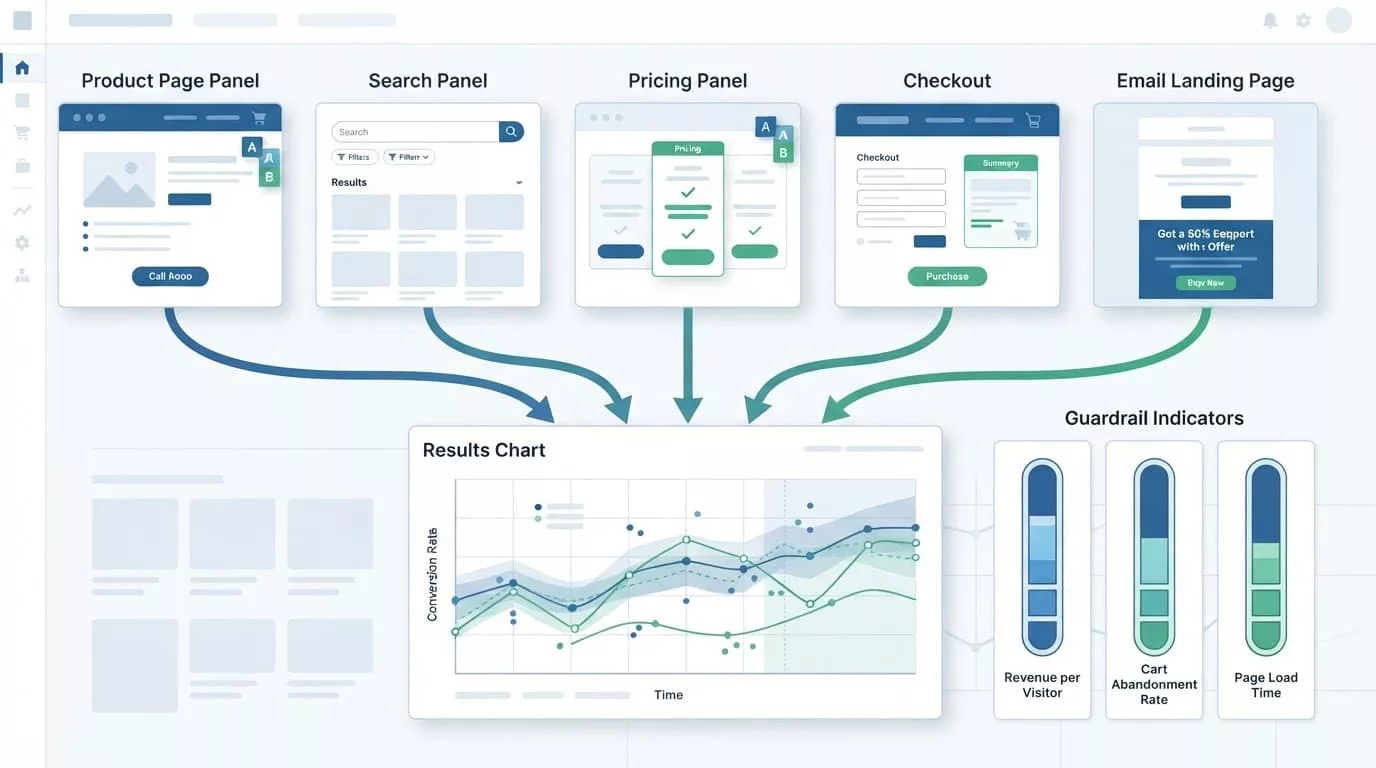
Add guardrail metrics that protect the wider customer and business experience. Common guardrails include:
- Average order value and gross margin.
- Payment failure and form error rates.
- Refunds, cancellations, and returns.
- Page performance and accessibility errors.
- Customer support contacts.
- Unsubscribe rates for email-driven traffic.
A useful guide to A/B test metrics and guardrails shows why a primary conversion metric can’t carry the entire decision. A test that lifts clicks while hurting completed orders needs a different outcome than a clean improvement across the funnel.
Account for sample size, timing, and overlap
Statistical validity depends on the baseline rate, expected effect, sample size, allocation, and decision threshold. Estimate those inputs before launch. The result should tell you whether the observed difference is strong enough for the decision, not merely which line is higher.
A difference between variants can occur through chance. This A/B testing guide to statistical significance provides a plain explanation of that issue. Don’t stop the test when the result first looks favorable, and don’t keep checking until a preferred outcome appears.
Timing can distort results. Seasonal demand, payday cycles, promotions, holidays, stock changes, and media coverage can affect one test period differently than another. Novelty effects can also make a new layout perform well or poorly at first, then settle later. Record campaign dates and major site changes beside the test results.
Test overlap creates another problem. Two experiments may change the same checkout step, audience, or metric. Use mutually exclusive audiences where possible. Otherwise, document the overlap and avoid making strong claims about either result without considering the interaction.
Create a repeatable review and learning loop
Prioritization should change as the team learns. A backlog that never records outcomes will keep producing the same guesses.
Hold a short weekly scoring review
Invite the people who own customer experience, commercial goals, analytics, and delivery capacity. Keep the session focused on decisions:
- Add new evidence to existing ideas.
- Re-score tests when the problem, traffic, or effort changes.
- Select the next experiment and confirm its owner.
- Move blocked work into discovery or technical preparation.
- Review recent results and update related backlog items.
Avoid debating every score for an hour. If two people disagree, record the reason and decide what evidence would settle it. A score is useful when it makes disagreement visible.
Store the result beside the original hypothesis
When a test ends, record the control, variant, audience, dates, sample size, primary result, guardrails, segments reviewed, and decision. Add one sentence about what the team learned.
A result can produce several types of value:
- A winning variant that is ready for rollout.
- A losing variant that prevents an expensive release.
- An inconclusive test that needs more traffic or a sharper question.
- A surprising result that changes the team’s understanding of the customer problem.
Mixpanel’s experimentation documentation describes how experiment reports compare variant performance against selected metrics. Whatever platform you use, connect the result to the next decision instead of filing it as a presentation slide.
Apply the framework to a sample backlog
The table below uses the formula in this article. Scores are illustrative, so your team should adjust them to its data and delivery constraints.
| Experiment idea | Impact | Reach | Confidence | Learning | Alignment | Effort | Score |
|---|---|---|---|---|---|---|---|
| Clarify mobile payment errors | 5 | 5 | 4 | 3 | 5 | 2 | 20 |
| Show selected variant in sticky CTA | 4 | 5 | 3 | 4 | 4 | 2 | 18 |
| Improve zero-result search recovery | 4 | 3 | 3 | 5 | 4 | 4 | 15 |
| Test a product bundle offer | 5 | 4 | 2 | 5 | 5 | 5 | 16 |
| Rewrite an acquisition landing page | 3 | 4 | 3 | 3 | 3 | 3 | 13 |
The payment-error test leads because it combines broad reach with strong evidence and modest effort. The bundle offer has a slightly lower final score despite high strategic value because it needs more preparation. That doesn’t make it a bad idea. It makes the required investment clear.
The search test is a good example of high-learning work. Its score may rise if zero-result searches are frequent or if search influences a large share of revenue. The landing-page rewrite should move higher only when the team can tie the message problem to qualified traffic or downstream orders.
What a strong prioritization process avoids
A framework can still fail when teams use it mechanically. Watch for patterns that produce busywork rather than useful decisions.
Don’t treat scores as guarantees
A score estimates the value of running a test under current assumptions. It doesn’t predict the lift, prove the problem, or remove the need for QA.
High-confidence evidence can still point to a weak solution. Low-confidence ideas can produce important discoveries. Keep the assumptions visible and revise them after each experiment.
Don’t promote winners without a rollout check
A winning result may depend on a campaign, device mix, product category, or temporary stock position. Review planned segments, then monitor the primary and guardrail metrics after wider release.
A result that works for returning customers may not work for first-time visitors. A mobile improvement may have no effect on desktop. These differences should shape the rollout, not become a reason to search endlessly for a favorable segment.
Conclusion
A useful A/B test prioritization process helps ecommerce teams spend scarce design and engineering time on the problems that matter most. Score impact, reach, confidence, learning value, alignment, and effort, then balance the queue so quick wins don’t eliminate strategic work.
The strongest backlog connects each test to evidence, a decision rule, and a complete measurement plan. When seasonality, novelty, guardrails, statistical validity, and test overlap are part of the review, a neutral result can still improve the next choice.