

Chemical buyers rarely leave because the price is a little high. They leave when they cannot tell whether the product is still usable, how it should be stored, or when it expires.
On chemical product pages, shelf life messaging UX does more than display a date. It lowers doubt, supports internal review, and helps buyers act with less back-and-forth. When that information hides in a PDF or uses vague wording, people slow down.
The best pages give shelf life, storage conditions, and opening rules the same visual priority as price and variant choice. They also give teams a message that is easier to defend. The sections below show how to do that without cluttering the page.
Why shelf life details matter before the add-to-cart click
Shelf life questions are rarely small questions. A buyer wants to know if the product has an expiration date, whether storage changes that date, and if the clock starts at manufacture or after opening. If the page skips those details, the buyer has to guess.
That guess creates friction. In chemical commerce, friction often turns into a support email, a sales call, or an abandoned cart. A clear page reduces that risk before it starts.
Shelf life and stability are related, but they are not the same. For a plain-language distinction, see stability testing vs. shelf-life testing. The product page still has to translate that technical reality into buyer language.
This fits the same structure used in UX-centric product pages, where the most important facts sit close to the decision point. For chemical products, that means shelf life is not a footnote. It is part of the buying case.
Most visitors scan for three things first:
- Expiration or use period
- Storage conditions
- Rules after opening
If those answers are visible, the page feels safer and easier to trust.
Place shelf life messaging where buyers already look
Placement matters as much as wording. A shelf life note that sits below a long description often gets missed, especially on mobile. The page should surface the information before the first long scroll.
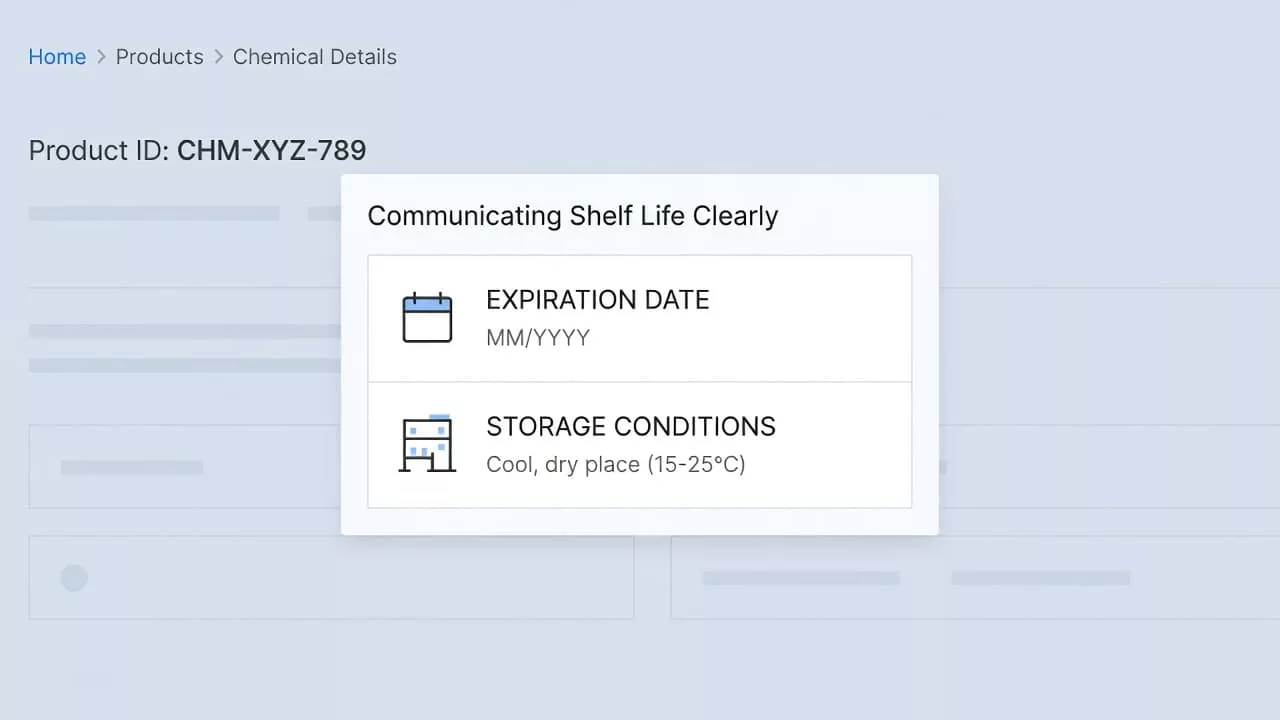
A few placement patterns work better than others.
| Placement | Best for | Sample message |
|---|---|---|
| Near the title or price | Short shelf lives or high-risk items | “Shelf life: 12 months unopened” |
| Under the buy box | Temperature-sensitive or regulated products | “Store at 2°C to 8°C. Do not freeze.” |
| In the specs area | Technical products with more detail | “Opened container use period: 6 months” |
That structure keeps the core facts visible without crowding the page. It also helps mobile shoppers, who often see only the top of the page before they decide whether to keep going.
When a product has variants, avoid hiding different shelf life rules inside a selector with no context. If one size has a shorter use period, surface that before the user clicks it. If a bundle ships with a different storage rule, say so where the bundle appears.
The goal is simple. The page should answer the buyer’s first safety and usability question before the hesitation grows.
Write shelf life and storage copy in plain language
Chemical product pages often fail because they sound technical in the wrong way. Words like “stable under standard conditions” or “retain efficacy” may feel precise, yet they leave buyers with more questions than answers.
If a buyer has to decode the date, the message has already failed.
Plain language works better. It should say what the product is, how long it lasts, and what changes that answer. If the shelf life depends on storage, spell out the storage rule. If opening the container changes the use period, state that directly.
Good message patterns are easy to scan:
- “Shelf life: 24 months unopened.”
- “Use within 6 months after opening.”
- “Store at 2°C to 8°C. Do not freeze.”
Each line gives one job to the reader. That makes the copy faster to read and easier to repeat across the site, order confirmations, and support macros.
The University of Vermont’s guidance on labeling and storing chemicals is a useful reminder that storage instructions need to be easy to find and easy to understand. A product page should follow the same idea. If the storage rule matters, it belongs near the product facts, not buried in a policy page.
Keep the wording aligned with the data behind it. If the team has a fixed shelf life test, do not turn that into a stronger promise. If the page uses a manufacture date, say that. If the product has a best-before date instead of a strict expiry, use the right label and keep it consistent.
The safest pattern is also the clearest one. Use the exact meaning the product team can support, then express it in buyer language.
Use tables and FAQs to answer hidden questions
Shelf life data rarely stands alone. It usually sits beside pack size, storage range, hazard notes, and handling steps. That makes a good case for a structured spec area.
Product specification tables work well when buyers need fast comparison across technical details. Shelf life can live there as one row, alongside temperature limits and opened-container guidance. The table gives the page a fast scan path, while the surrounding copy adds context.
FAQs help when the same questions show up across many SKUs. A compact FAQ near the bottom can answer them without crowding the buy box. Product page FAQs are a strong fit for questions like these:
- Is the shelf life counted from manufacture or shipment?
- Does opening the container change the use period?
- What happens if the product is stored outside the recommended range?
If a variant changes the answer, show that in the selector, the spec table, or both. A single generic FAQ is not enough when one pack size ships differently or one formula has a shorter use period.
This is also a good place to connect page content with support content. The product page can handle the short answer. The FAQ can handle the second question. That split keeps the main page clean while still reducing support load.
A clear table plus a short FAQ gives buyers the feeling that the page already thought through their concerns. That matters, because shelf life questions often appear right before the decision to buy.
Common shelf life messaging mistakes on chemical pages
The most common mistake is hiding shelf life in a PDF and hoping buyers will open it. They often won’t. If the answer matters to purchase, it should appear in the page body.
Another mistake is using one message for every product. A solvent, adhesive, coating, or lab reagent may need different wording, even if the structure stays the same. Generic copy creates confusion, and confusion creates returns.
Watch for these problems:
- Vague labels that say “freshness” or “stability” without a clear time frame
- Mixed signals between the product page, label, and spec sheet
- Missing opening rules for items whose shelf life changes after first use
- Outdated copy after a formula, pack, or storage rule changes
A page can also fail when it sounds more confident than the data allows. If the shelf life is still under review, say that the product is pending final posting. Do not invent a number to fill the gap.
The strongest pages keep the same message in three places, the product detail area, the specs, and the support content. That consistency lowers risk for the customer and for the brand. It also makes reviews faster for internal teams, because the language no longer changes from section to section.
Conclusion
Chemical buyers do not want to hunt for shelf life details. They want a page that tells them, in plain terms, what lasts, how long it lasts, and what storage changes the answer.
That is why shelf life messaging UX matters so much on chemical product pages. Clear placement, simple wording, and consistent support content reduce hesitation and make the page easier to trust.
When the page answers the shelf life question before the buyer asks it, it supports both conversion and compliance-aware communication. That is the kind of clarity that keeps people moving.