


When a catalog hits six figures, the first thing to break is rarely the platform. It’s the ecommerce taxonomy underneath it.
Bad structure spreads fast. Search gets noisy, filters stop helping, teams create duplicate categories, and product discovery turns into guesswork. In 2026, large catalogs also need to support AI classification, composable commerce, and cross-channel merchandising without losing control.
That means taxonomy can’t sit in a spreadsheet nobody owns. It has to work like shared infrastructure.
Where large catalogs usually go off track
Large catalogs fail when categories try to do too many jobs at once. A category becomes a browse node, a campaign page, a search synonym, and a supplier import bucket. Soon, nobody agrees on what belongs where.
The biggest issue is confusion between hierarchy and attributes. “Running Shoes” is a category. “Waterproof,” “wide fit,” and “recycled materials” are usually facets. When teams blur that line, they create thin pages, duplicate paths, and filters that compete with categories.
Taxonomy also affects more than navigation. It drives category discovery with breadcrumbs, on-page filters, internal linking, and BreadcrumbList structured data. If the structure is messy, those systems inherit the mess.
Use this rule set when teams debate placement:
| Element | Best use | Don’t use it for |
|---|---|---|
| Category | Stable browse path | Short-term campaigns |
| Facet | Filtering within a category | Replacing hierarchy |
| Collection | Merchandising or seasonal groupings | Permanent taxonomy |
| Synonym | Search matching and language variants | Navigation labels |
The takeaway is simple. Categories stay stable. Facets refine. Collections flex.
If one product can sit in five competing hierarchies, the model is already too loose.
Build a structure that scales, not a perfect tree
A strong taxonomy is less like a museum map and more like a well-run warehouse. Every aisle has a purpose, and every label helps people move faster.
Start with one primary browse path for each product family. You can still support cross-linking, related collections, and search synonyms. However, the main hierarchy should stay predictable. For most enterprise catalogs, three to four levels are enough.
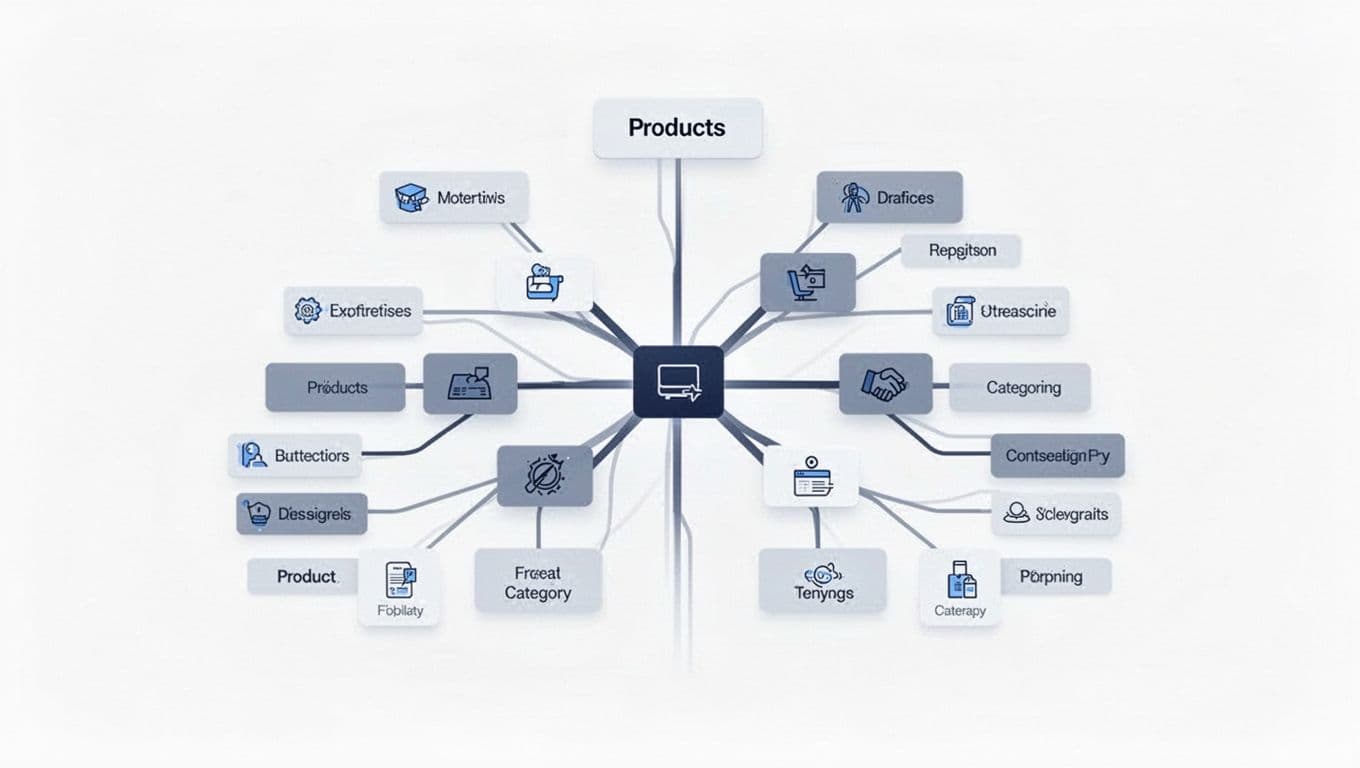
Name categories in shopper language, not ERP language. Supplier terms often sound precise but confuse buyers. Teams building global catalogs should also map regional vocabulary, because “trainers” and “sneakers” may point to the same set.
Facets need the same discipline. Keep only attributes that help people narrow choices or that power search, recommendations, and ranking. In 2026, many teams also add sustainability data, such as recyclability or sourcing claims. Those usually work better as controlled attributes than new top-level categories, unless search demand proves otherwise.
For a practical outside view, these product categorization guidelines and this product taxonomy guide that scales line up well with what enterprise teams see in real catalog work.
Add AI-assisted classification, but keep human control
AI can sort faster than a manual team. It can read titles, descriptions, images, and supplier feeds, then suggest categories, facets, and missing attributes. That matters when thousands of new SKUs land each week.
Still, AI should suggest first, not govern alone. Recent coverage on AI data readiness and catalog quality makes the same point: good output depends on clean source data and clear rules.

A workable model looks like this:
- Train on approved products and controlled attributes.
- Auto-accept only high-confidence, low-risk assignments.
- Route edge cases to taxonomy owners or merch ops.
- Audit drift every month, then retrain.
Your PIM should remain the system of record. AI can enrich and classify, but the approved taxonomy should publish from one governed source into storefronts, search, marketplaces, and feeds.
This is where composable commerce helps. Instead of burying rules inside one platform, teams can expose taxonomy services through APIs to search, merchandising, and content systems. That also makes it easier to separate permanent taxonomy from campaign logic.
Be selective with indexable facet pages, too. Some combinations deserve landing pages, but most do not. If your team struggles with filter sprawl, this guide on how to manage filter URL indexing is a useful checkpoint.
Connect taxonomy to search, merchandising, and governance
Taxonomy fails when it lives in isolation. Search teams add synonyms in one tool, merchandisers build rules in another, and product ops changes attribute values in the PIM. The customer sees the mismatch immediately.
Search should use the same attribute model as navigation. If “waterproof” exists as a filter, it should also work in query understanding, ranking, and recommendations. Likewise, merchandising should use collections and rules on top of taxonomy, not inside it.

Governance keeps that alignment in place as the catalog grows. In practice, that means clear owners, change rules, version control, and routine QA. It also means saying no to ad hoc category requests unless demand, content depth, and reporting needs support them.
A simple governance rhythm works well for most enterprise teams. Review new category requests monthly. Track zero-result searches and filter usage weekly. Audit duplicate labels and orphaned attributes every quarter. Then publish changes like product releases, with testing and rollback notes.
Recent writing on taxonomy and categorization for customer experience reflects the same shift in 2026: taxonomy is now an operating discipline, not a one-time IA project.
A large catalog doesn’t need more categories. It needs better rules.
Start with your top revenue-driving branches. Check whether category names, facets, search behavior, and PIM attributes tell the same story. If they don’t, fix that first.
That’s the real job of ecommerce taxonomy in 2026, giving every team one shared map, so customers can find the product before they lose patience.