

Complex B2B catalogs punish weak search design. A buyer might type a full MPN, a compliance code, a dimension string, or a plain-language request like “food-grade hose for CIP line”, and each query needs a different path to the right product.
That is why keyword search vs semantic search is the wrong way to frame the problem for most technical catalogs. The real task is matching exact identifiers when precision matters, then understanding intent when buyers search the way they speak.
The strongest systems do both, and they do it in the right order.
What each search mode is built to handle
Keyword search and semantic search solve different problems, and complex catalogs need both. Keyword search is direct. It matches tokens, values, and strings. Semantic search reads the intent behind the query and looks for meaning, synonyms, and related concepts.
Here is the practical split:
| Search mode | Best at | Common B2B examples | Main risk if used alone |
|---|---|---|---|
| Keyword search | Exact matches, part numbers, codes, controlled terms | SKU, MPN, NDC, UDI, IEC rating, RoHS code | Misses synonym-heavy or vague queries |
| Semantic search | Intent, synonyms, natural language, substitutes | “replacement for obsolete valve”, “sterile tubing for lab use” | Can drift away from exact identifiers |
| Hybrid search | Precision plus discovery | Exact item first, related items next | Needs careful tuning and clean data |
Keyword search is the backbone of technical catalog search because many buyers already know what they want. They may not know the product name, but they know the code. In electronics, that could be an MPN. In industrial supplies, it could be a bearing size, a thread pitch, or a legacy part number. In medical supply catalogs, it could be a UDI, NDC, or packaging code.
Semantic search shines when the buyer knows the job, not the label. That difference sounds small, but it changes everything about how queries should rank.
If you are also cleaning up dead ends, how to fix zero-result searches belongs in the same project. Zero results often happen when the engine does not understand the search type.
Where keyword search still wins
Keyword search is the safer first line of defense when precision is non-negotiable. That includes SKU lookups, MPN searches, regulatory codes, exact dimensions, and customer-specific catalogs with fixed terminology. If a buyer enters 6205-2RS, the system should not guess. If someone searches NEMA 4X enclosure 24x18, the engine should protect those exact tokens.
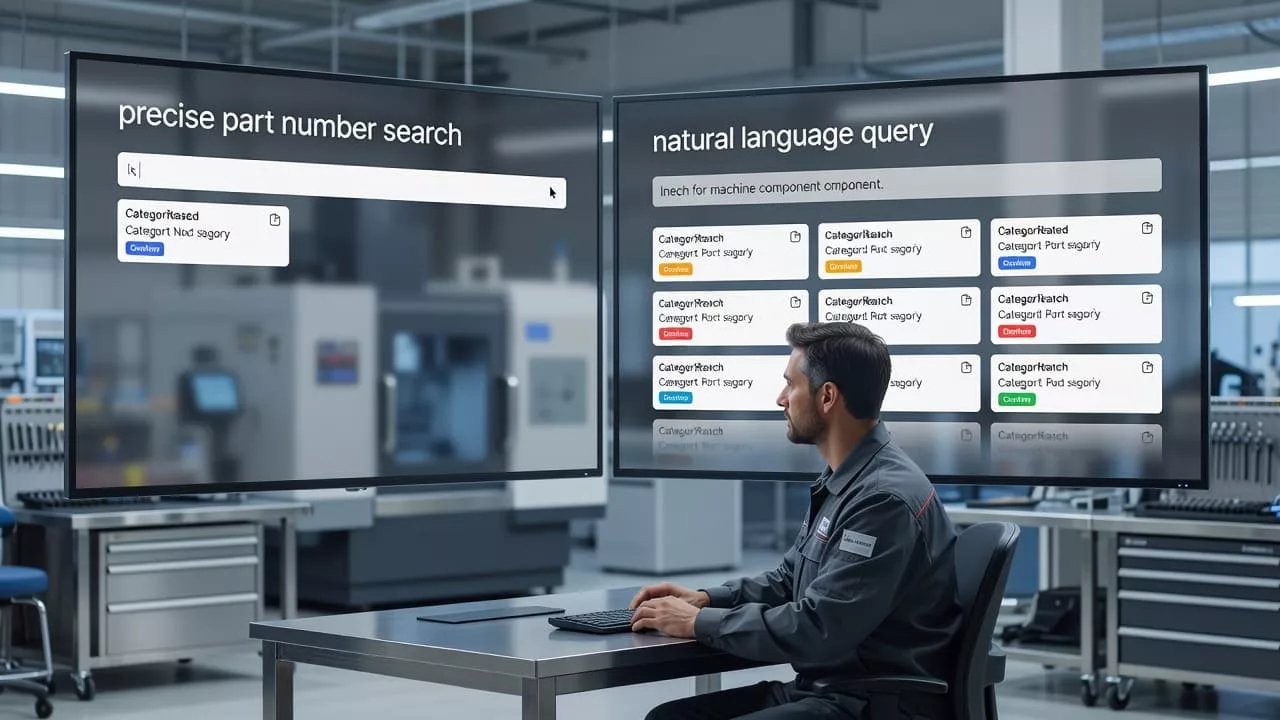
This is where keyword search also helps with compliance-heavy catalogs. A hospital buyer may search for “latex-free exam gloves” or “sterile gauze 4×4”. A plant engineer may search for “IP67 connector” or “UL94 V-0 housing”. Those phrases look natural, but they still depend on exact catalog values.
The danger is over-relying on semantic expansion too early. If a catalog treats every query like a broad intent query, it can bury the exact match under related items. That frustrates experienced buyers fast. B2B shoppers often want speed, not exploration.
A good keyword layer also handles catalog governance. It can preserve preferred terminology, legacy aliases, and customer contract language. That matters when procurement teams expect one specific label and nothing else. Search should not “help” by changing the meaning of a code.
For teams working on the search experience, search results page UX best practices matter as much as retrieval. A perfect match still fails if the results page hides it or forces too much scanning.
Where semantic search helps buyers move faster
Semantic search earns its keep when buyers search with imperfect language. That happens all the time in B2B. Someone may type “bearing for high heat conveyor”, “replacement for discontinued pump seal”, or “FDA-approved clear tubing”. The query is useful, but it does not map cleanly to a single string.
Salesforce’s overview of semantic search intent describes the core idea well, the engine interprets meaning rather than just matching words. Algolia’s take on semantic search for ecommerce makes a similar point, and the logic applies even more strongly in B2B catalogs with deep attribute sets.
Semantic search helps in three places:
- Synonyms and domain language: A buyer says “solenoid valve”, the catalog stores “electromagnetic valve”. A purchasing manager says “masking tape”, the product line uses “industrial pressure-sensitive tape”.
- Intent phrases: Queries like “replacement for”, “compatible with”, and “equivalent to” often signal a need for substitutes, not exact matches.
- Application-based search: Buyers rarely search by part class only. They search by use case, such as “food processing”, “cleanroom”, “corrosion resistant”, or “high-temp environment”.
This is why semantic search works so well in catalogs for manufacturing, electronics, and medical supplies. Buyers do not always know the product taxonomy. They know the constraint, the application, or the problem.
Still, semantic systems should not invent relevance. They need guardrails. A search for “wireless sensor” should not surface every connected device with the word “sensor” in the description. Meaning matters, but structure matters more.
Why hybrid search is the practical default
The best B2B search stacks do not force a choice. They route the query. Exact identifiers go through lexical matching first. Vague, descriptive, or synonym-heavy queries get semantic treatment. The two paths can then merge through ranking and reranking.
If the query looks like a part number, protect the exact match first. If it reads like a need, widen the search path.
That model works because buyer intent is mixed. A single catalog may get all of these on the same day: a procurement manager pastes an MPN, a technician searches by size, and an engineer types a problem statement. One retrieval method cannot handle that range cleanly.
Hybrid search also gives merchandising teams more control. You can pin exact matches, boost stocked items, promote contract-specific assortments, and still let semantic expansion help with discovery. The goal is not to replace keyword logic. The goal is to keep it from getting trapped by literalism.
This is also where query mapping matters. If your catalog team already uses synonyms, typeahead rules, or query routing, you are halfway to a hybrid stack. Onsite search optimization strategies are part of that same workflow, because good routing depends on clean query intent and clear result types.
Data quality sets the ceiling
Semantic search only performs as well as the data behind it. If product attributes are messy, duplicate, or inconsistent, the engine will surface messy results faster. That is because it understands more of the catalog, not less.
For complex B2B catalogs, the minimum data requirements are strict:
- normalized part numbers and aliases
- structured attributes with consistent units
- product family, compatibility, and variant relationships
- compliance tags, certifications, and region-specific restrictions
- stock status, lead time, and substitution rules
- strong taxonomy and category hierarchy
A PIM or product data platform has to do more than store descriptions. It has to control naming, attribute mapping, unit conversion, and variant inheritance. If one record says “stainless steel” and another says “SS”, the search layer should not be forced to guess whether they are the same material.
This matters even more when catalog data comes from multiple sources. ERP feeds, supplier files, and legacy catalogs often disagree on structure. Before anyone tunes search, the product team has to decide which source wins for each field.
A clean catalog also helps with faceted navigation. Search should understand whether a query asks for a product type, a feature, or a filter. That distinction matters when a buyer searches for “3/8 hose” versus “chemical-resistant hose”. One query is dimension-heavy. The other is application-heavy.
Semantic search in B2B catalogs can only go so far without disciplined metadata. Good search is a data problem before it is a model problem.
Relevance tuning needs rules, not guesses
Relevance tuning is where many teams lose the plot. They turn on synonyms, enable vector search, and hope the engine figures it out. That approach usually creates fuzzy rankings and frustrated buyers.
A better approach is simple and controlled:
- protect exact identifiers with lexical priority
- expand synonyms only when they fit the product family
- use application terms and attribute mappings for broader queries
- keep availability, contract pricing, and lead time as tie-breakers, not primary relevance signals
- separate global search rules from customer-specific rules
That last point matters in B2B. A distributor may have different assortments for different accounts. A manufacturer may have region-specific catalogs or approved substitutes. Search rules should respect those boundaries. Otherwise, the same query returns different quality depending on who is logged in.
Category-specific tuning helps too. The word “seal” can mean a gasket, a closure, or a compliance mark. The word “filter” can mean a component, a cartridge size, or a technical outcome. Search models need context from the taxonomy, not only from the query string.
Human review still matters here. Build a small set of real queries from customer service logs, sales notes, and site search logs. Review what the engine returns today, then adjust the rules in the direction of buyer behavior. If the results feel right only in theory, the tuning is wrong.
What to measure before and after launch
Search projects often claim success too early. A better evaluation stack tracks both retrieval quality and business outcomes. The best teams watch the numbers by query type, because an MPN search should not be judged the same way as a natural-language query.
| Metric | What it shows | Why it matters |
|---|---|---|
| Zero-result rate | How often search fails outright | Reveals coverage gaps and missing synonyms |
| Reformulation rate | How often buyers retype the query | A sign that the first result set missed the intent |
| Search CTR | How often results earn a click | Helps judge ranking quality |
| Search-to-conversion rate | Adds to cart, quote requests, sample requests | Connects search to revenue |
| Exact-match accuracy | SKU, MPN, and code precision | Protects the highest-stakes queries |
| nDCG or MRR | Ranking quality on curated test sets | Useful for offline testing before launch |
Do not stop at one metric. A lower zero-result rate can hide worse ranking. A higher CTR can still produce poor conversion if the top result is attractive but wrong. The right mix shows whether search is accurate, useful, and profitable.
A disciplined team also creates a golden query set. That set should include exact identifiers, synonym-heavy phrases, and vague intent queries. If the engine performs well on all three, the catalog search is getting closer to the real job.
Building the stack in 2026
Most modern B2B search stacks in 2026 use hybrid retrieval. A lexical engine handles exact matches, a vector layer captures semantic similarity, and a reranker chooses the final order. On top of that, teams add filters, faceting, telemetry, and experimentation.
A practical rollout usually follows this order:
- Audit the top search queries and classify them by type.
- Clean the product data before changing the search model.
- Build lexical rules for SKUs, MPNs, and compliance codes.
- Add semantic retrieval for vague, synonym-heavy, and application-based queries.
- Use a reranker to balance exactness, availability, and relevance.
- Test against a query set before wider release.
- Monitor logs, refine synonyms, and adjust category rules.
LLMs can help with query classification, synonym suggestion, and intent rewriting. They can also assist with product enrichment at scale. However, they should stay inside guardrails. They should not override canonical product data, compliance fields, or approved substitutes.
The best architecture is usually boring in the right way. It uses strong structured data, fast retrieval, visible rules, and clear feedback loops. Fancy models help only when they sit on top of disciplined product information.
Conclusion
Complex B2B catalogs need precision first and discovery second. Keyword search protects the queries that already carry exact meaning, such as SKUs, MPNs, and compliance codes. Semantic search helps when buyers speak in outcomes, substitutes, and applications.
The strongest answer is usually hybrid. Clean data, careful relevance rules, and the right metrics give you a search system that can handle both the engineer with a part number and the buyer with a problem statement.
That balance is what makes search useful in a serious catalog, and it is what keeps buyers moving when the query is messy.