
Most product pages don’t lose sales because the product is bad. They lose sales because the page makes shoppers work too hard. The title is fuzzy, the bullets feel generic, and the product descriptions read like a spec sheet.
Great Product Page Copy, the core of your marketing Product Page Copy, acts like a helpful store associate in your digital storefront. It says what it is, why it matters, what problem it solves, and what happens after you click “Add to cart”, all in a quick skim. Effective Product Page Copy helps buyers make informed decisions.
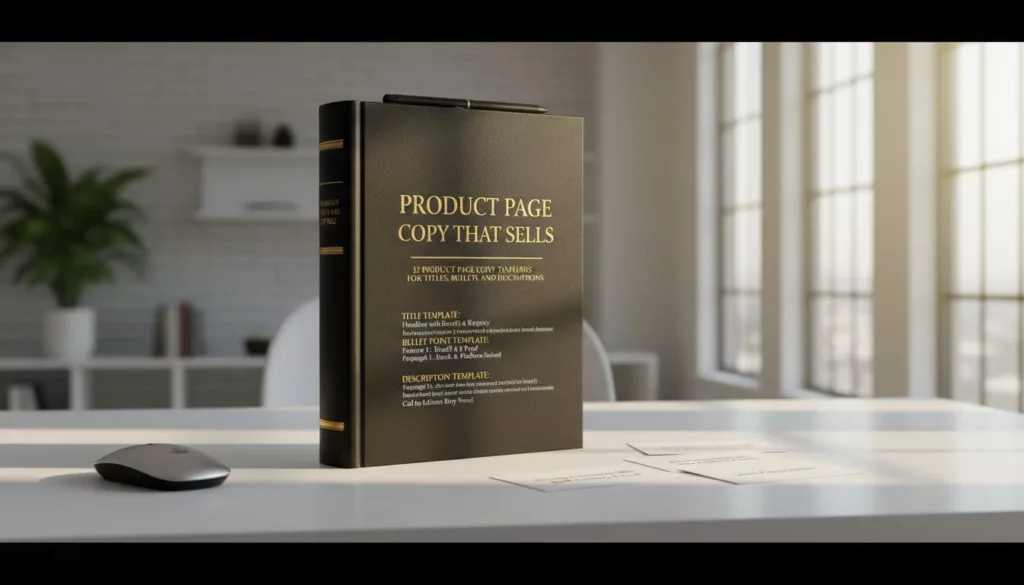
Below are 12 plug-in templates you can use for titles, bullets, and descriptions, plus mobile tips, proof ideas, and a copy/paste checklist.
What high-converting product page copy needs to do
Effective Product Page Copy should resonate with your target audience, highlighting key features and benefits that encourage purchases.
Think of your product page like a short guided tour, akin to effective landing page copy on other high-stakes pages. Each section has a job:
- Title: Confirm the shopper (your target audience) is in the right place (what it is) and hint at the payoff (why they want it).
- Bullets: Make the features and benefits scannable and remove doubts fast (size, fit, use, care, compatibility, what’s included).
- Description: Add context, tell a simple story, and handle objections you couldn’t fit above the fold.
A fast self-check for conversion rate: if someone only reads the title, the first 3 bullets, and the first 2 lines of the description, do they still get the point?
If you want a solid baseline for product descriptions, Shopify’s guide is a good refresher: product description examples and templates.
12 plug-in templates for titles, bullets, and descriptions
### Headline formulas (use these copywriting templates for H1 + SEO title)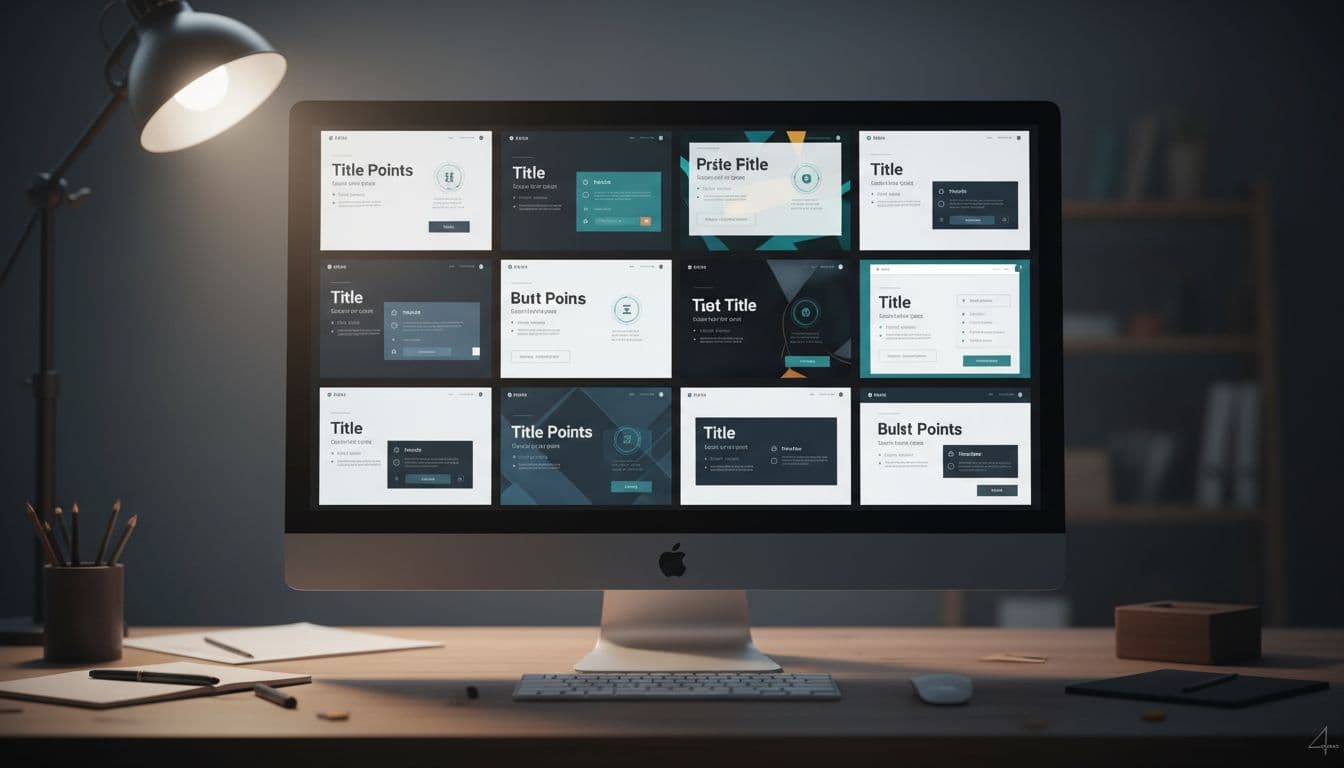
1) Outcome-first title
Utilizing templates for your Product Page Copy can streamline the writing process and ensure consistency across your listings.
When crafting Product Page Copy, remember to focus on clarity and persuasion to maximize your conversion potential.
Formula: [Result] + [Product Type] (for [Audience/Use])
When to use: Clear, desired outcome; easy to picture with headline formulas.
Strong example: “All-Day Comfort Running Socks (No-Slip Fit)”
Weak example: “Premium Socks”
Quick fix: Add a result and a use case.
2) Problem-solution title
Formula: [Product Type] that [Solves Pain Point]
When to use: The buyer already feels the pain points.
Strong example: “Shower Filter that Cuts Chlorine Smell and Dryness”
Weak example: “Shower Filter for Home”
Quick fix: Name the pain point, not the category.
3) Differentiator title
Formula: [Product Type] with [Unique Feature]
When to use: One feature truly sets you apart (material, method, design).
Strong example: “Cast-Iron Skillet with Pre-Seasoned, Smooth Finish”
Weak example: “High-Quality Skillet”
Quick fix: Replace “high-quality” with the specific difference.
4) Bundle clarity title
Formula: [What’s Included] + [Product Type] (in [Count/Size])
When to use: Kits, refills, multi-packs, and bundles.
Strong example: “3-Pack Glass Meal Prep Containers (Leak-Resistant Lids)”
Weak example: “Meal Prep Set”
Quick fix: Put the count and key reassurance in the title.
Consider customer pain points while creating Product Page Copy that addresses their needs and concerns directly.
Bullet copywriting formulas (use these copywriting templates for the “scan zone”)
5) Feature to benefit bullet
Formula: [Feature] , so you can [Benefit]
When to use: You need to connect specs to real life.
Strong example: “Double-wall steel, so your coffee stays hot longer”
Weak example: “Double-wall steel design”
Quick fix: Finish the sentence with the outcome.
6) Objection-buster bullet
Formula: Worried about [Objection]? [Proof/Reassurance].
When to use: Fit, sizing, durability, mess, learning curve.
Strong example: “Worried about sizing? Use our 30-second fit guide.”
Weak example: “Multiple sizes available”
Quick fix: Call out the fear, then solve it.
7) Use-case bullet
Formula: Perfect for [Scenario] , especially when [Situation].
When to use: Your product shines in specific moments.
Strong example: “Perfect for carry-on travel, especially on 2-day trips”
Weak example: “Great for travel”
Quick fix: Add a concrete scenario and time frame.
8) What’s included bullet
Formula: Includes: [Item 1], [Item 2], [Item 3].
When to use: Anything with parts, accessories, refills, or setup.
Strong example: “Includes: 2 filters, 1 housing, quick-start guide”
Weak example: “All accessories included”
Quick fix: List the items, shoppers hate surprises.
Description copywriting formulas (use these copywriting templates below the fold)
9) Two-line promise + details
Formula: Line 1: [Big promise]. Line 2: [How it works in plain words]. Then details.
When to use: Mobile-first pages, fast skimmers.
Strong example: “Smoother skin in one step. This gentle scrub uses fine sugar and jojoba oil for a clean rinse.”
Weak example: “Our product is formulated to deliver results…”
Quick fix: Start with the outcome, then say how.
10) “Before and after” mini story
Formula: Before: [Pain]. After: [Relief]. Bridge: [Why this product].
When to use: Commoditized categories that need emotion (apparel, home, beauty).
Strong example: “Before: cords everywhere. After: one clean dock. Our weighted base stays put while you plug in.”
Weak example: “This dock is designed for your desk.”
Quick fix: Paint the messy “before” picture.
Ultimately, great Product Page Copy is about storytelling that aligns with your brand’s values and the needs of your audience.
11) Compare and choose (without a full chart)
Every successful Product Page Copy will contain elements that are designed to build trust and ease in potential buyers.
Your Product Page Copy must be distinct and engaging to stand out from competitors in the crowded online marketplace.
Formula: If you want [Priority A], choose this. If you need [Priority B], choose [Variant/Other].
When to use: Variants, sizes, strengths, bundles, subscriptions.
Strong example: “If you want maximum hold, choose Strong. If you prefer a softer feel, choose Flex.”
Weak example: “Available in multiple options.”
Quick fix: Tell people which option fits their goal.
12) Proof-led description block
Formula: [Social proof] + [Specific claim] + [Risk reversal]
When to use: Higher price points, new brands, low trust categories.
Strong example: “Top-rated by verified buyers. Built with 600D fabric for daily carry. Try it for 30 days, return it if it’s not for you.”
Weak example: “Customers love it. High quality. Satisfaction guaranteed.”
Quick fix: Make proof and guarantees concrete.
For more inspiration on how strong copy pairs with layout, review a few high-converting product page examples.
Mobile-first formatting and adding social proof without clutter
On mobile, the first line of every section is the “hook”. Keep it short.
Mobile rules that usually win:
Understanding Product Page Copy is essential for e-commerce success. This guide will walk you through creating compelling Product Page Copy that converts visitors into customers.
- Put the clearest value in the first 6 to 10 words.
- Keep bullets to one line when possible.
- Use numbers when you can (time saved, count, capacity, weight), but only if true.
- Repeat key details near the “Add to cart” call to action (shipping, returns, fit help).
Proof you can add fast:
- Reviews: show a star average plus a few specific quotes from customer testimonials (not “Love it!”).
- Stats: only use verifiable numbers (test results, units sold, warranty years).
- Trust: clear returns, warranty, and what’s included.
- Visual proof: short demo video captions that match your bullets.
If you want a bigger set of copy frameworks to borrow from for your high-converting sales page, OptinMonster’s roundup is useful: copywriting templates and formulas.
Claims, compliance, and safe wording that still sells
Product pages get risky when copy promises outcomes you can’t prove, especially for health, skincare, supplements, and medical-adjacent products where even meta descriptions require careful phrasing.
Use language that stays strong but honest while preserving your brand voice:
- Prefer “designed to”, “helps support”, “may help”, “can help you” (when true).
- Avoid guaranteed medical outcomes unless you have the backing and the approvals.
- Don’t imply typical results are universal, especially in Amazon listings. Add “results vary” when needed.
- If you mention endorsements or reviews, don’t edit them into new claims.
- Keep comparisons fair and avoid unsubstantiated product guarantees (“lighter than our previous model” is safer than “lightest on the market” unless proven).
For broader product copy guidance and examples, BigCommerce’s resource is handy: guide to product copywriting.
Remember that your Product Page Copy should always focus on the customer and their journey from interest to purchase.
Effective Product Page Copy connects emotionally with customers by addressing their aspirations and desires.
Mini swipe files: words to use and words to avoid
To optimize your Product Page Copy, test different headlines and calls to action to find what resonates best with your audience.
Incorporating keywords like Product Page Copy throughout your content enhances SEO and helps attract the right audience.
Your Product Page Copy can also benefit from user-generated content, such as reviews and testimonials, to enhance credibility.
Creating a sense of urgency within your Product Page Copy can motivate customers to make quicker purchasing decisions.
These swipe files offer a quick reference to sharpen your copy, especially in AI copywriting where high-impact words can elevate automated drafts. Swap out empty phrases for ones with punch to beat writer’s block and keep your creative flow strong.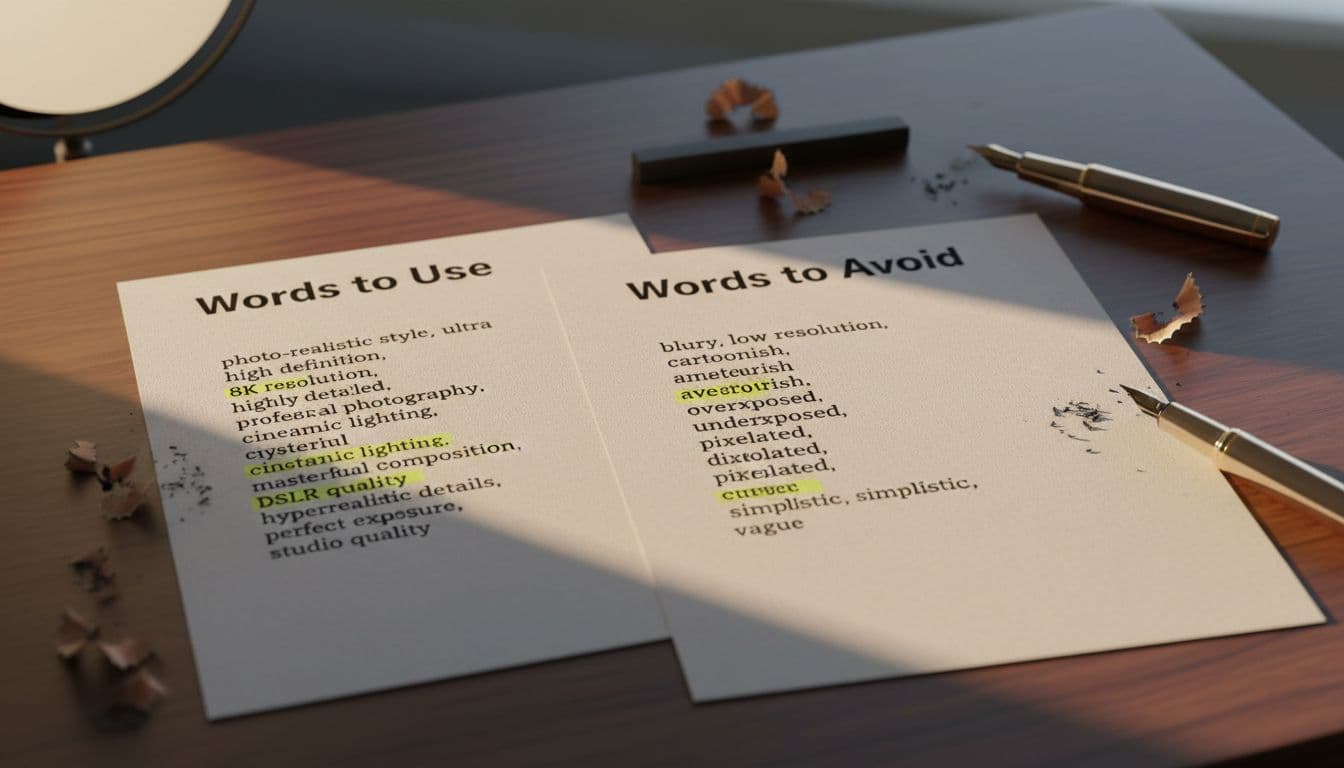
10 high-impact words and phrases (use when accurate):
Make sure to regularly update your Product Page Copy to reflect current trends and maintain relevance in your market.
- “Fits in”
- “Made for”
- “Ready in”
- “No-mess”
- “All-day”
- “Built to last”
- “Grip”
- “Breathable”
- “Leak-resistant”
- “Try it for 30 days”
10 words to avoid (they sound empty):
- “Premium”
- “High-quality”
- “Best”
- “Revolutionary”
- “Unique”
- “State-of-the-art”
- “World-class”
- “Luxury”
- “Innovative”
- “Perfect”
Copy/paste product page copy checklist (one page)
– [ ] Title says what it is and why it matters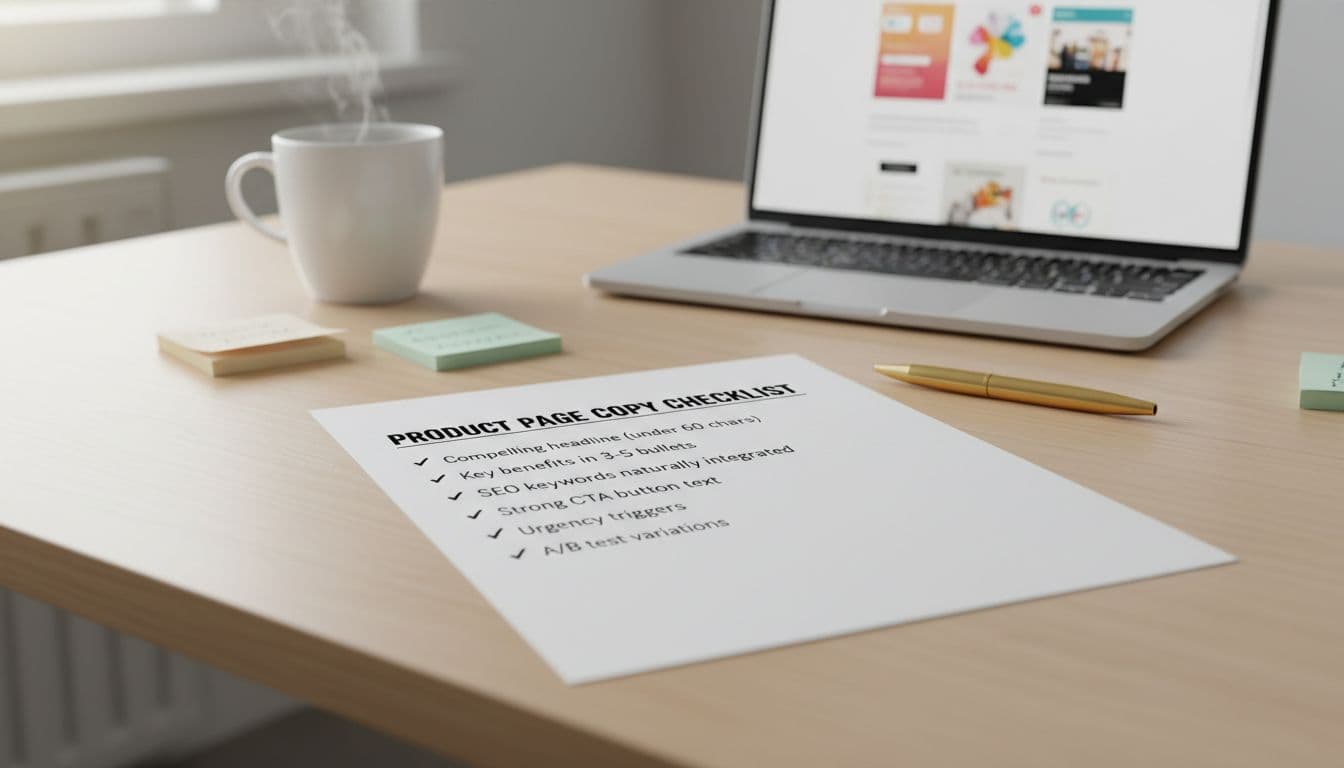
- [ ] Title includes count/size when it’s a bundle
- [ ] First bullet answers the top buying reason
- [ ] One bullet handles the #1 objection (fit, sizing, compatibility)
- [ ] One bullet states what’s included (no surprises)
- [ ] Bullets are benefit-led, not spec dumps
- [ ] First two lines of description work on mobile
- [ ] Description includes one clear use case
- [ ] Description explains who it’s for (and who it’s not for)
- [ ] Proof is visible near the buy area (reviews, stats, guarantees)
- [ ] Claims are specific, supportable, and not overstated
- [ ] Shipping and returns are easy to find
- [ ] Any required disclaimers are present (results vary, care notes)
- [ ] No vague filler words where specifics could go
- [ ] Read it out loud, remove anything that sounds salesy
Product pages don’t need more words; they need the right words in the right spots. Start by fixing the title, tightening three bullets, then rewriting the first two lines of the description. Do that across your top sellers’ website copy, and you’ll feel the difference in your conversion rate and in fewer “quick question” support emails.
These copy rules apply just as well to sales email templates in your email flows, including welcome emails and cold email templates. The same benefit-led principles shine in Facebook ads, punchy email subject lines, and sales page templates. Check our sales page templates for more ways to tighten overall brand messaging.
As you refine your Product Page Copy, keep the user experience at the forefront to ensure easy navigation and comprehension.
In summary, strong Product Page Copy is an indispensable tool in driving sales and enhancing customer satisfaction.
Leverage data and insights to continually improve your Product Page Copy to meet ever-evolving customer expectations.
Finally, remember that your Product Page Copy is an ongoing process of refinement and adaptation to changing market dynamics.