

One wrong option in a complex product quote can create rework, margin loss, or a failed order. When teams compare CPQ with ecommerce configurators, they’re often comparing two systems that support different parts of the buying process.
An ecommerce configurator helps buyers choose and visualize a product at the front end. CPQ software, which means Configure, Price, Quote, validates complex rules, calculates commercial terms, and produces a sales-ready offer. For enterprise ecommerce teams, the right choice depends on configuration depth and what happens after a customer makes the first selection.
Key Takeaways
- Ecommerce configurators focus on visual product selection, customer experience, and straightforward purchases, while CPQ software governs complex rules, pricing, approvals, and formal quotes.
- Choose an ecommerce configurator when products have bounded options, transparent pricing, and standard fulfillment data.
- Choose CPQ when configurations involve dependencies, customer-specific pricing, negotiated terms, approval thresholds, or manufacturing outputs such as BOMs and CAD references.
- A hybrid model connects a visual storefront with CPQ, CRM, and ERP systems so customers can configure products easily while sales and operations maintain commercial and production control.
- Evaluate platforms using real scenarios, including invalid combinations, discounts, quote revisions, product changes, outages, and order handoffs.
CPQ vs ecommerce configurators: different owners for the sale
An ecommerce product configurator creates a customer experience built around visible choices. It lets buyers select colors, dimensions, materials, components, or accessories while viewing the result. A 3D product configurator makes those changes easier to understand than a group of static product photos.
The usual output is a valid variant from the product catalog, a SKU, a shopping cart line, or a quote request. Its main job is to reduce uncertainty and help a buyer reach a purchase decision.
CPQ software works deeper inside the commercial and operational process. It applies business logic to component dependencies, customer-specific pricing, volume breaks, discount limits, tax rules, approval thresholds, and contract terms. It can support guided selling by helping users select valid combinations. The system can create formal quote documents and send structured data to CRM, ERP, or manufacturing systems.
The two categories overlap, especially when an interface includes real-time pricing. However, real-time option pricing does not necessarily provide account-level controls, formal approvals, or governed quote terms. The frontend usually prioritizes speed and clarity, while CPQ prioritizes control and transaction accuracy. Twikit’s comparison of product configurators and CPQ makes the same distinction between visual customization and B2B commercial logic.

This table shows where the capabilities usually sit.
| Capability | Ecommerce configurator | CPQ platform |
|---|---|---|
| Configuration rules | Guides compatible options, often at SKU level | Evaluates dependencies, constraints, revisions, and engineering rules |
| Pricing | Updates option and variant prices | Applies tiers, discounts, currencies, costs, margins, and account terms |
| Approvals | Usually limited to basic review | Routes discounts, exceptions, and risk decisions for approval |
| Quote generation | Creates a request or cart summary | Produces formal quotes with terms, validity, and line details |
| Ecommerce checkout | Usually a core feature | Requires connection to a commerce platform or order system |
| CRM and ERP integration | Often syncs products, customers, and orders | Connects configuration, pricing, quotes, orders, and account data |
| Channel partners | Supports limited shared access | Manages partner roles, pricing, permissions, and sales attribution |
| Production data | Usually sends selected SKUs | May generate BOMs, CAD references, routings, or production data |
For enterprise ecommerce, this choice affects both the sales process and the sales cycle. The frontend optimizes selection speed, while CPQ controls commercial accuracy.
A visual configuration tool can be the right choice even when CPQ features are available. Adding enterprise software to a simple product can create more administration than value.
Choose an ecommerce configurator when visual choice drives the sale
A product configurator fits products where customers can understand available choices without a salesperson or engineer. Furniture, office interiors, promotional products, consumer electronics, and modular fixtures often fit this model as modular products with bounded choices.
For example, a furniture buyer might choose a sofa fabric, leg finish, seat depth, and cushion type. A 3D product configurator can show finishes and dimensions as choices change, offer augmented reality previews, and provide real-time pricing. The buyer can then add the configured item to the shopping cart, and the order may need only a variant code and option list.
The same approach works for made-to-order products with a bounded set of choices. If combinations map cleanly to variants in the product catalog, inventory records, and fulfillment rules, a simple setup may be enough. That is less likely when account-specific dynamic pricing replaces predictable additions.
A visual interface can support conversion by answering questions before checkout. Buyers can see how a finish changes the product, what an upgrade costs, and whether one option works with another. This improves the customer experience and makes product customization easier to understand. Still, 3D visuals don’t solve unclear delivery dates, hidden fees, or confusing account pricing. Good product configurator UX design connects visual choices to useful information.
A simple customizer is usually enough when:
- The option count is manageable, and compatible options follow simple rules.
- Pricing follows a visible base price plus predictable additions.
- Customers can buy without negotiated terms or sales approval.
- The order needs standard product data rather than custom technical data.
Photo swapping can work at the earliest stage. As configuration depth grows and options affect dimensions, fit, structural performance, or production steps, move toward structured rules instead of adding more image combinations.
Choose CPQ when quote validity matters more than instant checkout
CPQ software becomes more useful when a product behaves like a small project. Industrial pumps, commercial HVAC systems, power equipment, laboratory installations, network infrastructure, and engineered machinery are often made-to-order products. They often need more than visual selection, with parametric modeling aligning choices to dimensional or performance variables.
A buyer may choose a motor, capacity, control system, enclosure, installation service, warranty, and delivery arrangement. One selection can change the allowed values for several others. As dependencies, services, and negotiated terms increase, manual validation lengthens the sales cycle and raises rework risk.
The platform keeps rules in a controlled model, using guided selling to recommend valid options while blocking invalid combinations. Its pricing logic supports dynamic pricing based on customer-specific terms, segment, region, volume, freight, currency, and negotiated agreements. When discounts exceed thresholds, the system can route quotes for approval, replacing email and spreadsheet handoffs in the sales process. A visual CPQ layer can preserve self-service while the backend governs the transaction.
Formal quote generation matters when customers need documents for procurement, finance, or internal approval. A quote may include commercial terms, product descriptions, lead times, services, recurring charges, validity dates, and revisions. Buyers may also need to save the configuration, share it with colleagues, or convert an approved quote into an order.
A product configurator can display a valid-looking choice while CPQ rejects it because the rule set, product revision, or account price differs.
Channel partners add another reason to consider CPQ. Dealers and distributors may need restricted catalogs, territory pricing, delegated approvals, and visibility into their own opportunities. A consumer-style configurator rarely handles those permissions well without extensive custom development.
How hybrid visual CPQ connects commerce and operations
Many manufacturers need both experiences. Buyers want a clear, visual storefront with a product configurator for modular products and product customization. Sales and operations need governed pricing and production data without compromising the customer experience. For enterprise ecommerce, a hybrid visual CPQ model connects the storefront with governed commercial and operational services.
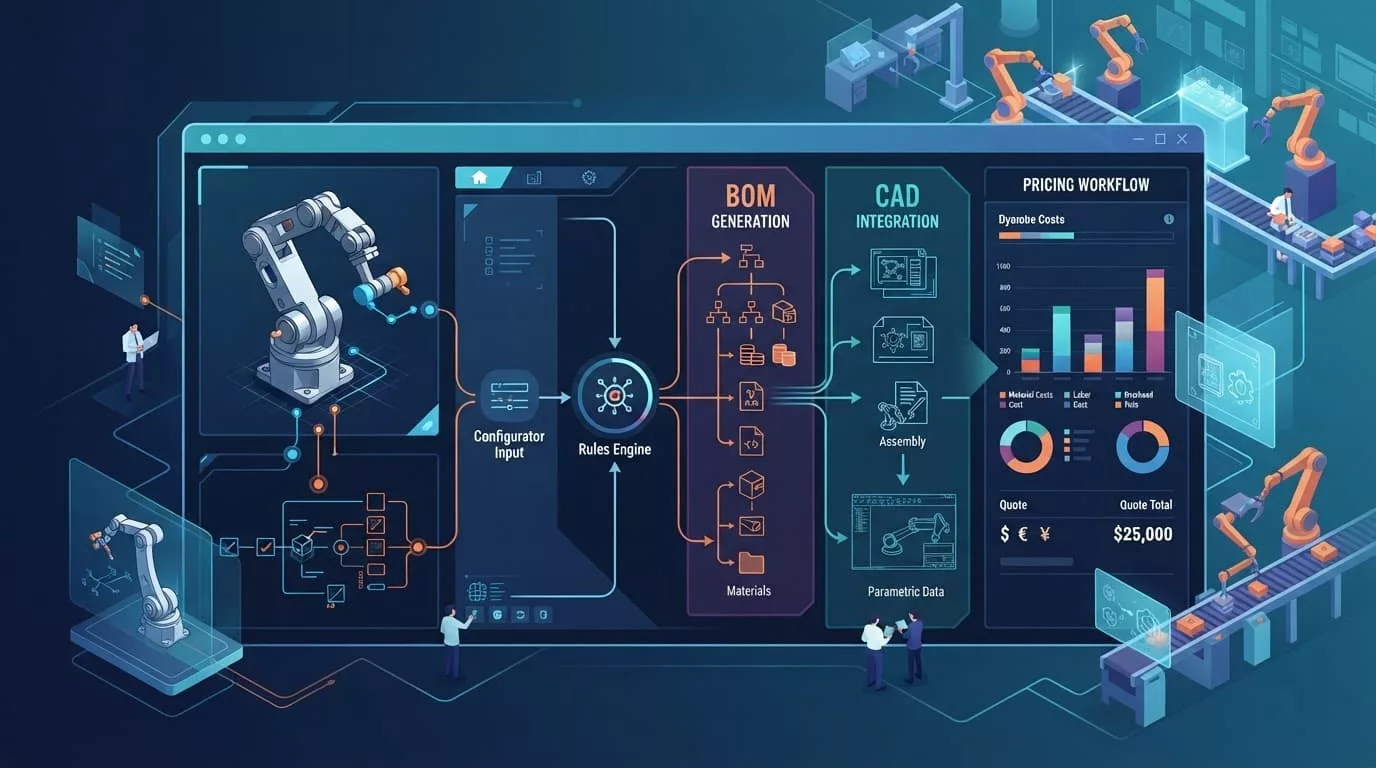
Customers start on a storefront built with ecommerce platforms such as Shopify, WooCommerce, Magento, or a custom frontend. The 3D product configurator collects selections, displays 2D or 3D changes, and may show real-time pricing. CPQ remains the authority, receiving each configuration through an application programming interface, or API.
CPQ software validates selections, applies pricing logic, and enforces business logic for dependencies and controls. It handles dynamic pricing by account or market, supports quote generation, and returns an approved price, quote, or checkout status. The commerce platform displays the result, saves the configuration, or presents the next step, such as checkout, quote request, or sales review. Salesforce can manage the opportunity and account relationship, while SAP or another ERP can own order management, inventory, finance, and fulfillment records.
Headless e-commerce integration creates real technical work. Teams must manage authentication, session continuity, API latency, product-version control, tax and shipping calculations, error messages, and retry behavior. They also need a clear answer to a difficult question: which system owns the price when the storefront, CPQ platform, CRM, and ERP each hold related data?
A reliable integration usually passes a configuration ID and rule-set version, not only a list of selected options. That record preserves versioned product data and parametric modeling inputs, so support and manufacturing can reproduce what the buyer approved. It also prevents a later product update from silently changing an existing quote.
The strongest hybrid designs allow several paths. A standard configuration can move from the shopping cart directly to checkout. A high-value or unusual configuration can become a quote. A sales representative can edit the same configuration within CPQ without forcing the buyer to start again, preserving approved data for manufacturing outputs.
Costs, timelines, and manufacturing outputs
The visible interface is only one part of the investment. Total cost includes software licenses, implementation, integration, product-data cleanup, rule modeling, user training, testing, and ongoing administration. CAD automation and ERP connections can add more work than the 3D layer itself.
Use planning ranges rather than vendor promises. A clean, SKU-based configurator can often launch in four to eight weeks. A broader engineered rollout for made-to-order products may take three to six months, while implementation spanning enterprise ecommerce, multiple products, regions, and partners can take six to twelve months or longer.
The timeline grows when product data lives in spreadsheets, engineers own undocumented rules, or regions use separate commercial models. A short discovery phase should map products, rules, approval paths, integrations, and outputs before the team selects a platform.
Advanced systems can generate a bill of materials, or BOM, that lists the components required to build the configured product. They may also produce CAD files for computer-aided design. Parametric modeling adjusts dimensions or features when defined variables change, but engineering must review the results and control revisions.
Those outputs require more than a visual customizer. Engineering must define the model, manufacturing must confirm the component logic, and operations must decide how revisions move into production. A product configurator that creates attractive product views but sends ambiguous order data still leaves the hardest work to staff.
A practical selection test for B2B teams
In a B2B evaluation, start with the most failure-prone order. Trace its configuration depth across the sales process and sales cycle. Follow every decision through pricing, approval, order entry, and production.
Choose a product configurator when buyers can make a valid purchase using product catalog data and transparent pricing. Choose CPQ software when controlled pricing, approvals, account terms, or product validity depend on rules that sales and operations must manage.
Choose a hybrid model when visual self-service matters, but orders also need formal quoting, account pricing, partner access, or manufacturing outputs. The frontend should make decisions easy. The backend should make those decisions safe to sell and build.
Ask each vendor to demonstrate a real configuration with an invalid combination, a customer-specific discount, an approval threshold, a quote revision, and an order handoff. Then test a second product configurator scenario with guided selling, and confirm it identifies compatible options while rejecting invalid combinations across ecommerce platforms. Ask where the final price lives, how product revisions are handled, whether e-commerce integration remains available during an outage, and how the order management handoff works.
Frequently Asked Questions
What is the main difference between CPQ and an ecommerce configurator?
An ecommerce configurator helps customers select and visualize product options, often leading directly to a cart or quote request. CPQ software validates complex configurations, applies commercial rules, manages approvals, and produces formal quotes.
When is an ecommerce configurator enough?
A configurator is usually enough when products have a manageable number of compatible options, predictable pricing, and standard fulfillment requirements. It works best when customers can purchase without negotiated terms, sales approval, or custom technical data.
When should a business use CPQ software?
CPQ is more appropriate when products have complex dependencies, account-specific pricing, discounts, approval thresholds, or engineered outputs. It helps sales and operations maintain accurate quotes and reduce rework during the sales and order process.
Can a company use CPQ and an ecommerce configurator together?
Yes. A hybrid setup can provide a visual storefront for customer self-service while CPQ remains the authority for configuration validation, pricing, quotes, and commercial controls.
How should teams evaluate these platforms?
Teams should test a real, failure-prone configuration from product selection through pricing, approval, quoting, order entry, and production. Vendor demonstrations should include invalid combinations, customer-specific discounts, quote revisions, product-version changes, and the final order handoff.
Conclusion
The difference between CPQ and ecommerce configurators comes down to ownership. An ecommerce product configurator owns the buyer’s product selection and shopping experience, while CPQ software owns the rules, commercial controls, and quote process behind a complex sale.
Manufacturers with bounded options can gain more from a focused configurator than a full CPQ platform. Businesses selling engineered products, negotiated deals, or multi-channel offers usually need CPQ, often connected to a visual commerce experience. The best architecture is the one that makes the product easy to choose and the resulting order accurate enough to build.