
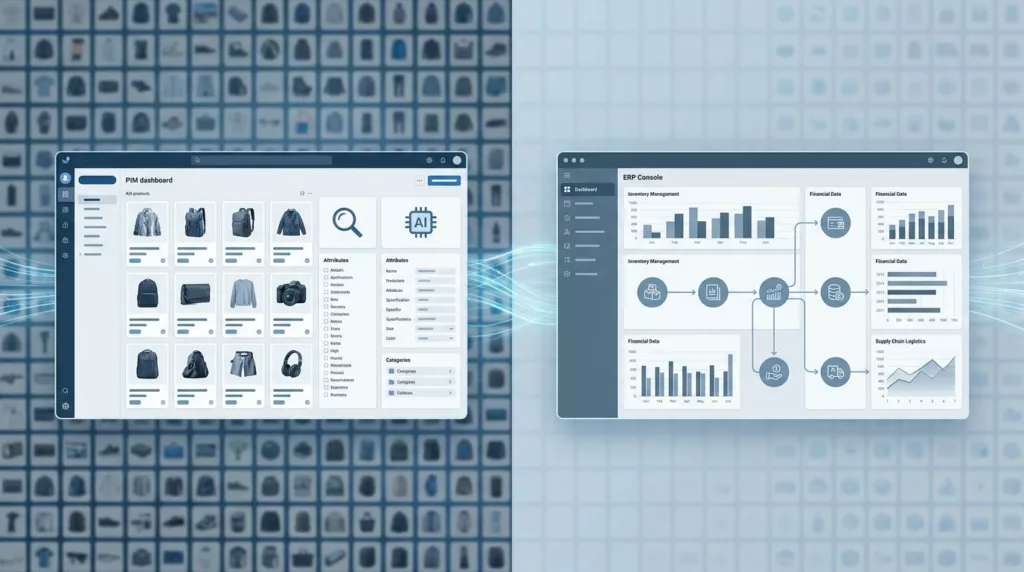
Large ecommerce catalogs do not fail because they are large. They fail when inventory, finance, and product content sit in the wrong systems.
By 2026, that problem gets sharper. AI search, marketplace syndication, localization, and real-time stock updates punish messy data fast. If you’re weighing PIM vs ERP, the right answer usually comes down to where your catalog pain lives and which team owns it.
Why large catalogs expose weak product data
A catalog with 500 SKUs can survive a few manual fixes. A catalog with 50,000 SKUs cannot. Every variant, supplier, locale, and sales channel adds another place for errors to spread.
That is why the debate is rarely about software alone. It is about control. ERP handles operational records well, but product teams still need to manage descriptions, images, attributes, and channel rules somewhere else. If your category tree keeps drifting, ecommerce taxonomy best practices should come before another software purchase.
Search and merchandising feel the strain first. A missing attribute breaks a filter. A bad category mapping hurts discovery. A duplicate title confuses a marketplace feed. Once that happens, the catalog becomes expensive to maintain, because teams stop fixing root causes and start cleaning up symptoms.
Supplier onboarding adds another layer of pain. One vendor sends clean spreadsheets. Another sends PDFs. A third sends half the data in email threads. Without a governed structure, onboarding new products turns into a chase.
Localization makes the issue even bigger. A single product may need one core record, plus several language versions, region-specific legal fields, and channel-specific copy. The bigger the catalog gets, the more product data starts to behave like an operating system, not a spreadsheet.
What ERP and PIM each own in ecommerce
Many teams blur the two systems until the catalog starts to strain. A concise PIM vs ERP breakdown from Pimcore makes the split easy to see, ERP is built for operations, while PIM is built for product content.
Here is the practical side-by-side view.
| Area | ERP | PIM |
|---|---|---|
| Primary job | Runs finance, inventory, purchasing, and orders | Manages product content, enrichment, and publishing |
| Best data | SKUs, costs, stock, supplier records, transactions | Titles, descriptions, attributes, images, translations, channel rules |
| Strength | Keeps operations accurate | Keeps catalogs complete and channel-ready |
| Weak spot | Limited content depth and syndication | Doesn’t run core transactions or accounting |
| Best for | System of record for business data | System of record for product content |
| 2026 pressure | Real-time inventory and order sync | AI-assisted enrichment, localization, marketplace feeds |
ERP should own the data that keeps the business moving. That includes item masters, stock, purchase orders, invoices, pricing logic, and supplier records. PIM should own the data that shoppers, partners, and marketplaces see first.
Sales Layer’s ERP and PIM comparison explains the same split in plain terms. ERP keeps the operation stable. PIM keeps the product story consistent across channels.
ERP keeps the books and stock right. PIM keeps the catalog ready for shoppers, marketplaces, and partners.
The key question is not which system is more important. The better question is which fields belong in each system, and who approves changes before they go live.
When ERP alone is enough
ERP alone can work when the catalog is narrow and stable. Think of a distributor with a few thousand SKUs, one storefront, limited regions, and product pages that need accuracy more than rich storytelling.
In that setup, a disciplined ERP can handle the basics well if the business conditions stay simple:
- Product attributes stay simple, and variants do not change often.
- The team sells through only a few channels.
- Suppliers already provide clean master data.
- Localization is light, or limited to a small set of fields.
- Product pages mostly need transaction data, not deep merchandising content.
That is a real use case, and it is common in B2B ecommerce. A replacement parts catalog, a spare-parts distributor, or a narrow direct-to-customer brand can often stay on ERP longer than a fashion or home goods retailer.
The warning sign appears when the team starts exporting CSVs to fix content. If merchandisers are editing product names in spreadsheets, translating descriptions by hand, or rebuilding feeds for each channel, the ERP is already doing work it was not built to do.
A site with limited content complexity can also stay lean on the storefront side. For teams focused on product page performance, strategies for optimizing product pages can help separate content issues from catalog system issues. If conversion problems come from weak copy or missing images, a PIM may be the missing piece. If the issue is mainly pricing, stock, or order flow, ERP may still be enough.
Where PIM becomes unavoidable
PIM becomes necessary when product content turns into the bottleneck. That usually happens long before the IT stack looks broken. The warning signs show up in merchandising, search, and supplier workflows first.
A large retailer with 20,000 or 80,000 SKUs might sell on its own site, Amazon, Walmart, partner portals, and regional storefronts at the same time. Each channel wants different title rules, bullet lengths, image order, attributes, and compliance fields. Trying to manage that in ERP alone usually creates more exports, more exceptions, and more cleanup.
Supplier onboarding also changes the equation. A PIM can give vendors templates, validation rules, and field guidance so the first upload is closer to publish-ready. That matters when each supplier has a different format and every missing attribute slows launch.
Localization is another tipping point. PIM helps teams keep one product truth while still creating language-specific and region-specific content. That includes translated titles, measurements, legal notes, and market-specific terminology. Without it, teams often end up with one global master file and dozens of manual variants.
PIM also helps with marketplace syndication. Marketplace feeds need structured data, category mapping, and attribute matching. If the data is not clean, listings get rejected or downgraded. If the data is not complete, search visibility drops.
AI-assisted enrichment makes PIM even more useful in 2026. AI can draft descriptions, suggest missing attributes, flag duplicates, and help with translation workflows. It can move the work faster, but it still needs governed source data and human approval. Clean templates matter more, not less, when automation enters the process.
This is where PIM stops being a nice-to-have. It becomes the layer that keeps the catalog publishable across channels.
How ERP and PIM should integrate in 2026
Modern ecommerce stacks are more modular than they were a few years ago. Many teams now run ERP, PIM, CMS, search, and marketplace tools as separate services connected by APIs. That fits composable commerce, but it only works if data ownership stays clear.
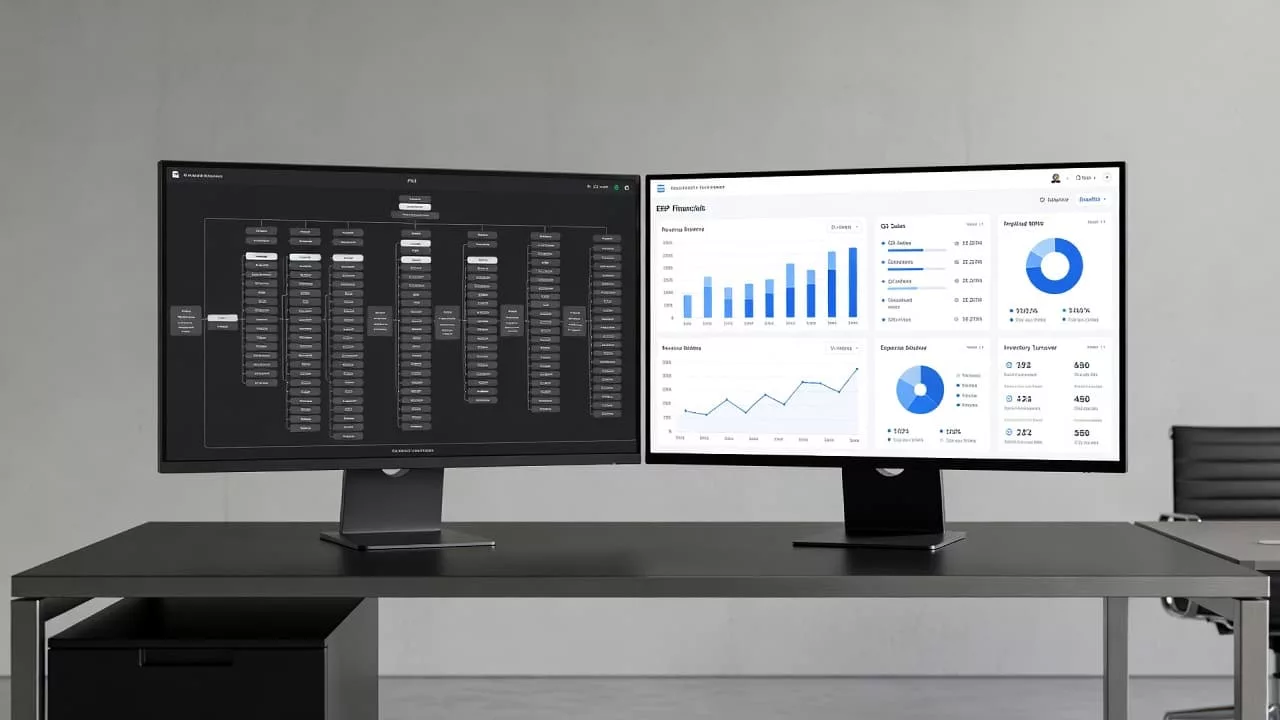
ERP should push the data that changes stock, cost, and fulfillment. PIM should pull that data, enrich it, and publish the channel-ready version. That includes product copy, attribute mapping, categories, imagery, translations, and feed rules.
The best integrations are event-based or API-based, not nightly file drops. Batch jobs still have a place, but they create lag. In 2026, lag is a problem when prices change, inventory runs low, or a marketplace needs fresh content fast.
The split also matters for governance. If a field affects finance or fulfillment, keep it anchored in ERP. If a field affects how a shopper chooses a product, govern it in PIM. That covers most of the catalog.
For some categories, the data set is getting broader too. Sustainability fields, material origin, and compliance attributes now matter more, especially with EU digital product passport requirements moving through product categories like batteries, textiles, and electronics. Those fields fit naturally in PIM when they are part of the product story, then sync back to ERP or other systems where needed.
AI should sit inside that structure, not outside it. Let AI assist with enrichment, translation, and validation. Keep approval rules in place. Otherwise, the catalog becomes faster to publish and harder to trust.
How to choose the right stack for your team
The best choice depends on catalog shape, not company size alone. A mid-market brand can outgrow ERP fast if it sells across many channels. An enterprise can stay on ERP longer if the catalog is narrow and stable.
Use these checks to size the need correctly.
-
Count your channels first.
If you only sell on one site, ERP may carry the load. If you sell through marketplaces, retailer portals, direct ecommerce, and regional stores, PIM usually becomes necessary. Each channel adds its own rules, and those rules multiply fast.
-
Measure content complexity, not just SKU count.
A catalog with 8,000 SKUs can be easier than one with 2,000 configurable products. If every item needs technical attributes, size charts, legal text, rich images, or region-specific claims, ERP alone starts to feel cramped.
-
Look at supplier onboarding volume.
If new suppliers need manual cleanup before products can go live, PIM can save time almost immediately. It gives you templates, validation, and approval workflows that keep bad data out of the storefront.
-
Check who owns product quality today.
If merchandising, ecommerce ops, and IT all touch the same fields without clear rules, your problem is governance. PIM can help, but only if the team agrees on field ownership and naming standards first. Otherwise, the tool just adds another place for confusion.
A useful test is this: if your team is spending more time fixing content than selling products, ERP is no longer enough. If your team is spending more time moving data between systems than improving the catalog, the integration design needs work.
This is also where automation should be selective. Automate repetitive tasks like feed mapping, attribute suggestions, and translation prep. Keep human review for claims, compliance fields, and top-selling products. That balance gives you speed without losing control.
The right answer for 2026 catalogs
Large catalogs do not need more software by default. They need the right split between operational truth and product content truth.
ERP belongs at the center of finance, stock, purchasing, and order data. PIM belongs at the center of descriptions, attributes, images, translations, and channel syndication. When each system owns what it does best, the catalog becomes easier to scale.
That split matters even more in 2026, because AI, automation, and channel growth reward clean data. If your catalog has to feed shoppers, marketplaces, and machines, one system cannot carry the whole load for long.