
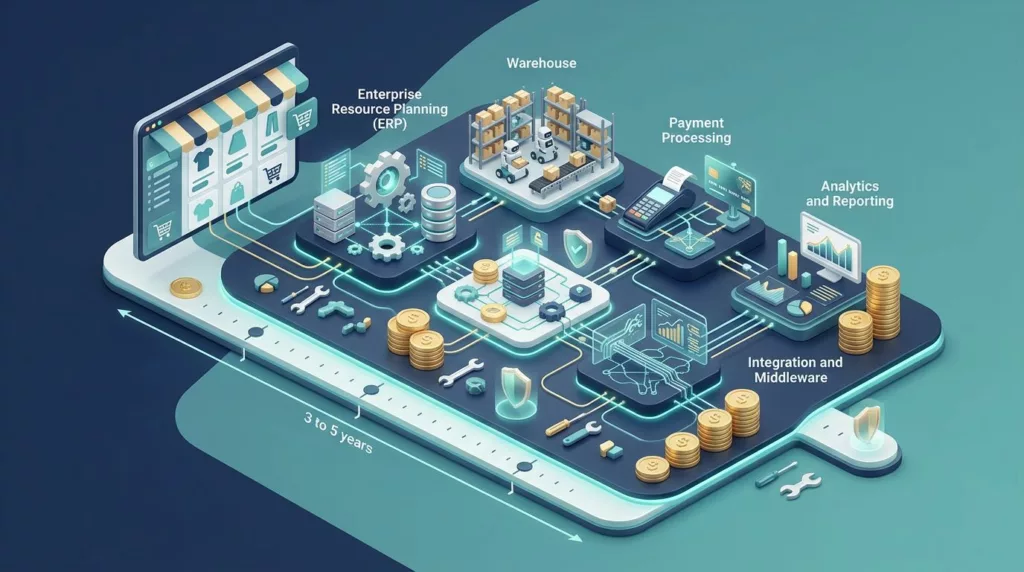
A low platform fee can hide a high operating bill. A credible B2B ecommerce total cost of ownership model counts the people, systems, integrations, changes, and risks that keep the channel working after launch.
That view matters in 2026 because B2B teams compare different platform approaches against the same business requirements. The winning platform offers predictable three-to-five-year ownership, manageable operational overhead, and a defensible cost of innovation, rather than the lowest entry price.
Key Takeaways
- A credible B2B ecommerce total cost of ownership model includes more than platform fees: implementation, integrations, data work, recurring operations, maintenance, internal labor, risk, and the cost of innovation.
- Compare platforms over three or five years using the same requirements, volumes, growth assumptions, and scenarios. Model fixed fees, GMV-based pricing, apps, middleware, payment processing, overages, and annual increases separately.
- ERP integration, data quality, custom workflows, and ongoing maintenance often drive more cost than the software license. Native B2B capabilities can reduce custom development, but they don’t eliminate governance, testing, training, or operational work.
- Keep gross TCO separate from business benefits such as automation savings, avoided costs, and revenue potential. A vendor comparison is more defensible when it shows assumptions, year-by-year cash outlay, uncertainty reserves, and the actual work each platform removes.
How to build a TCO model for B2B ecommerce
Total cost of ownership, or TCO, is the full cost of buying, launching, operating, maintaining, and changing a commerce platform over a defined period. Implementation costs are only one component of the model, while return on investment measures business results.
A useful TCO model separates gross cost from business benefits. Gross cost shows what the platform requires, including licensing and IT fees that may sit outside a vendor’s headline quote. Benefits show savings, revenue potential, and avoided costs. Keeping those figures separate prevents a vendor from making an expensive platform look cheaper through optimistic revenue assumptions.
A three-year model can use this structure:
TCO = one-time costs + recurring costs + growth and change costs + internal operating labor + risk allowances
Growth, workflow changes, and the cost of innovation belong in the change-related cost category.
Use five years when the business expects a long platform life, major ERP investment, or several replatforming scenarios. Use three years when comparing near-term payback, launch economics, and likely platform change risk.
The main cost categories are:
| Cost category | Typical model inputs |
|---|---|
| Platform fees | Subscription, license, GMV, orders, users, API calls, environments, overages |
| Implementation | Discovery, configuration, design, development, migration, testing, training, launch |
| Integrations | ERP integration, CRM, PIM, CPQ, OMS, WMS, tax, payments, search, identity, middleware |
| ongoing operational costs | Hosting, security, support, monitoring, backups, administration, compliance |
| Maintenance | Developer hours, upgrades, patches, app changes, regression testing |
| Change and innovation | New workflows, regions, channels, personalization, experiments, redesigns |
| Internal labor | Commerce administration, customer service, finance, merchandising, IT |
| Risk and opportunity cost | Manual workarounds, launch delays, outages, vendor lock-in, data quality issues |
A TCO guide for ecommerce platforms also treats opportunity costs as part of the broader ownership calculation. That matters in B2B because manual ordering work creates operational overhead and keeps sales and service staff busy for years.
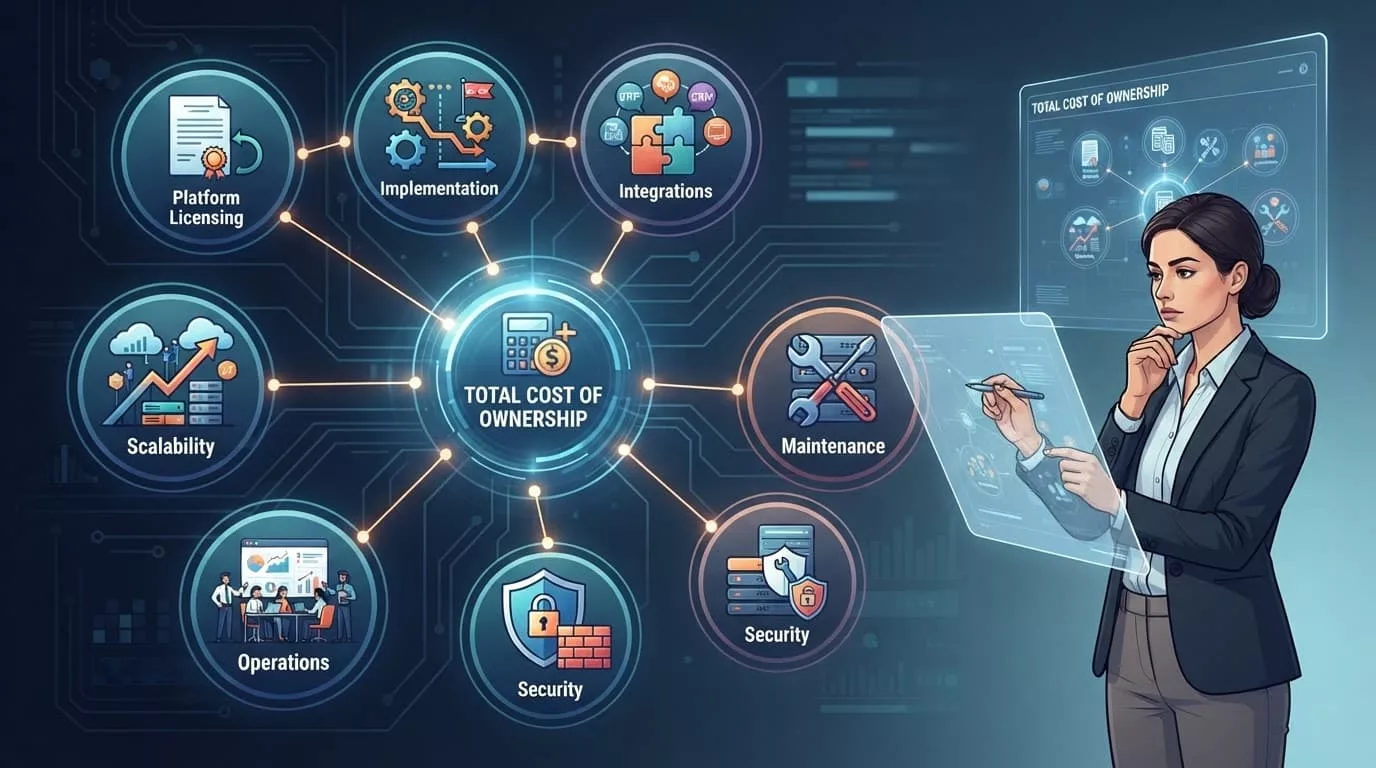
The model should show costs by year, not only as one large total. A $250,000 integration bill in year one affects cash flow differently from $250,000 spread across five years. It also lets finance test what happens when order volume, GMV, labor rates, or support needs increase.
Why implementation costs often exceed software licensing fees
The license gives you access to software. Implementation turns that software into a working buying channel for your company.
B2B commerce has more rules than a standard retail storefront. The platform may need to manage company account hierarchies, buyer permissions, customer-specific pricing, payment terms, and purchase orders. It may also need approval workflows, tax exemptions, sales territories, quotes, reorders, and invoice history. Each rule requires decisions about data ownership and user behavior.
Implementation costs usually include:
- Business and technical discovery
- Solution architecture and workflow design
- UX, theme, and front-end development
- Product and customer data migration
- ERP, CRM, PIM, and payment connections
- Configuration of pricing, catalogs, accounts, and approval workflows
- Quality assurance, security testing, and user acceptance testing
- Training, documentation, launch support, and project management
A platform with native B2B capabilities can reduce custom development. It doesn’t remove the need to map business rules or clean data before launch.
ERP integration is often the largest technical cost
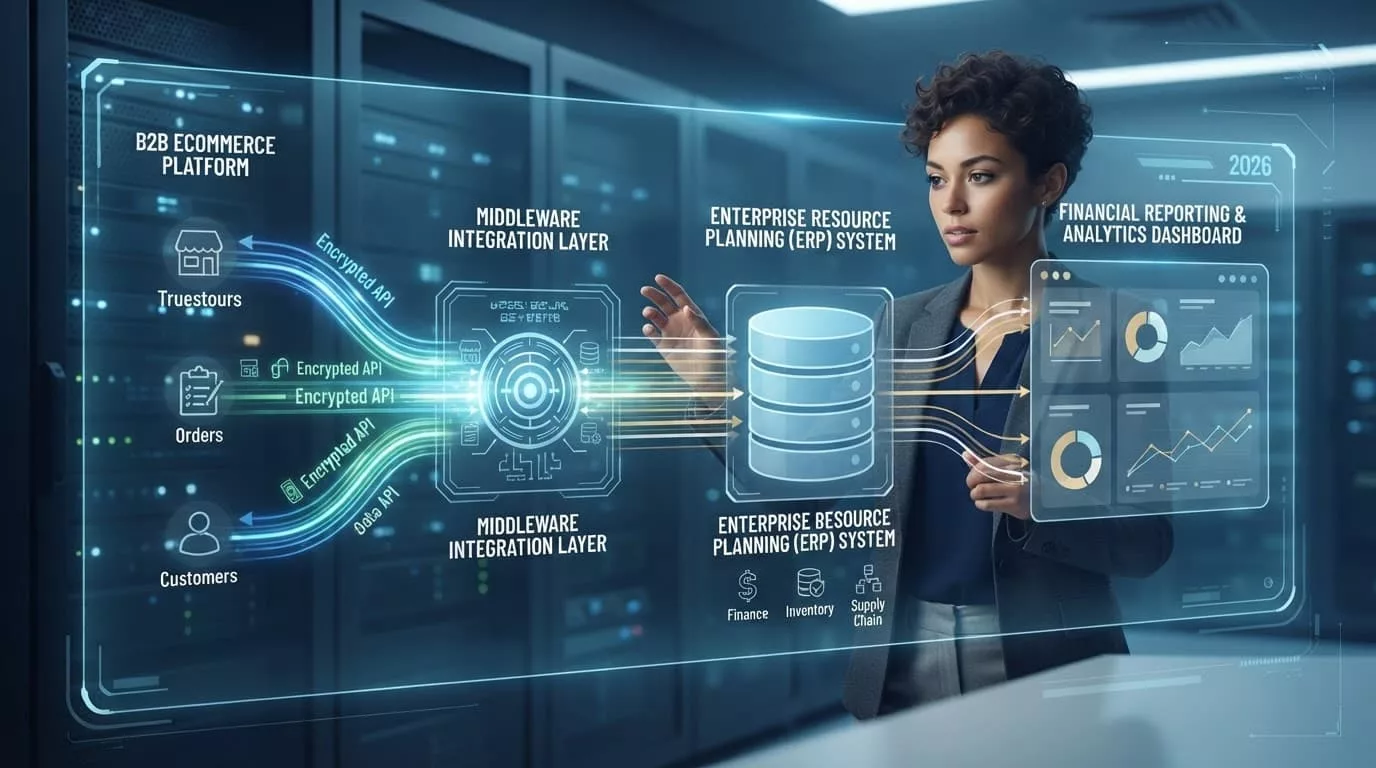
An ERP, or enterprise resource planning system, usually owns financial and operational records. Ecommerce needs access to some of those records without becoming a second ERP.
The integration must define which system owns each data type. For example, the ERP may own customer credit limits, while the commerce platform manages the buyer’s web session. The PIM may own product descriptions, while the ERP owns stock levels and cost data.
Common ERP integration work includes:
- Customer account and company hierarchy synchronization
- Contract price lists and negotiated terms
- Product, inventory, and availability updates
- Order submission and status updates
- Shipping, tax, payment terms, and credit checks
- Invoices, returns, credit memos, and dispute information
- Error handling, retries, duplicate prevention, and monitoring
The technical connection is only part of the cost. Teams must define ownership, retry rules, and monitoring. Testing must cover timing, failed messages, partial orders, cancelled lines, price changes, and duplicate customer records.
For a company with product configuration or complex pricing, the CPQ versus ecommerce configurators guide can clarify where pricing and configuration logic should live. That decision affects licensing, integration scope, testing, and future maintenance.
Data quality creates another implementation bill
A migration project rarely moves clean data from one system to another without preparation. Product records may contain duplicate SKUs, missing units of measure, outdated images, inconsistent attributes, or conflicting descriptions. Customer accounts may use different billing and shipping structures across regions.
Estimate data work as its own line. Include profiling, cleansing, mapping, transformation, validation, and post-launch correction. Otherwise, those hours disappear into the development estimate and make future changes harder to price. When omitted from the original estimate, cleansing, transformation, validation, and exception handling become daily operational overhead.
Implementation also grows when stakeholders request exceptions. A single approval flow may become several flows for different divisions. Poor mapping and unplanned exceptions make future custom development more expensive. A simple price list may need contract dates, quantity breaks, currencies, and sales-representative overrides.
How platform pricing changes the 2026 model
Comparing B2B ecommerce platforms requires a common business scenario. A subscription price alone doesn’t provide a fair comparison, and implementation costs remain outside a license-only view.
In 2026, common pricing structures include fixed subscription fees, GMV-based licensing, quote-based licenses, transaction charges, app costs, and infrastructure costs. Licensing and IT fees may sit alongside these charges, but not every fee comes directly from the platform. GMV means gross merchandise value, or the value of merchandise sold through the channel before deductions such as refunds.
GMV-based licensing deserves special attention. A fixed annual fee is easier to forecast as sales grow, while percentage pricing can remain affordable at low volume but become a major expense later. Model the fee at low, expected, and high forecast levels, rather than applying today’s cost to every future year.
Shopify Plus, for example, publicly lists a starting price of $2,300 per month on a three-year term. Its one-year term starts at $2,500 per month for standard setups and integrations. Higher-volume arrangements may include variable pricing or negotiated terms. Confirm the current commercial offer directly, because public commentary has reported different GMV thresholds.
Use the same requirements when comparing B2B ecommerce platforms. The following ranges are directional figures published in a 2026 mid-market comparison. They aren’t universal quotes and shouldn’t replace vendor proposals.
| Platform | Published three-year mid-market range | Main TCO questions |
|---|---|---|
| Shopify Plus | $100,000 to $300,000 | How will GMV terms, apps, payments, and ERP middleware change with growth? |
| BigCommerce | $150,000 to $400,000 | Which B2B Edition functions are included, and which workflows need apps or custom work? |
| OroCommerce | $350,000 to $900,000 or more | How much implementation, customization, infrastructure, and specialist support will the rollout require? |
| Adobe Commerce | $400,000 to $1,000,000 or more | What will licensing, cloud or hosting, development, patching, DevOps, and upgrades cost? |
The ranges come from 2026 B2B commerce platform pricing research. Treat them as planning markers, not a ranking. An Adobe Commerce or OroCommerce project may justify higher costs when the business needs extensive control, complex catalogs, or unusual workflows. A simpler operating model may favor Shopify Plus or BigCommerce when native features cover most requirements.
Adobe Commerce pricing is generally quote-based and can vary by business size, GMV, deployment model, and feature scope. Its flexibility can require more custom development, engineering effort, and infrastructure. Open-source solutions shift buyer responsibility; headless commerce can add integration work with SaaS, and neither automatically lowers cost. The buyer must include security updates, release management, performance testing, and specialist support in the model.
BigCommerce B2B Edition can reduce custom work for standard wholesale use cases, but an app-heavy architecture can increase recurring costs. Shopify Plus can reduce infrastructure responsibility, yet its app ecosystem and GMV terms need close review. OroCommerce is built for B2B use cases, but the total project cost depends heavily on implementation depth and available technical expertise.
Include Virto Commerce and SAP Commerce Cloud when enterprise integration, catalog, or deployment requirements make them credible candidates. Request the same cost detail from each vendor, including whether a BigCommerce B2B Edition proposal covers apps and custom work. When adding regions, workflows, or channels, include the cost of innovation and operational overhead from infrastructure, apps, or specialist support. Never compare one vendor’s license quote with another vendor’s fully managed operating estimate.
Recurring costs and the cost of innovation
Launch is the start of ownership. Recurring costs often determine whether the original business case remains credible.
Your annual operating budget should include ongoing operational costs. These may cover platform fees, subscription fees, middleware, payment services, tax services, search, hosting, monitoring, security, maintenance and support, analytics, and internal administration. Include developer time for releases and fixes in the recurring operating expenses.
Third-party apps create a common five-year blind spot. An app may cost $100 per month at launch, but the ownership cost can include:
- Integration and configuration work
- Data synchronization and monitoring
- Vendor support and renewal increases
- Compatibility testing after platform releases
- Replacement work if third-party apps are discontinued
- Additional QA when multiple apps interact
- Security and privacy reviews
A $1,000 monthly app stack costs $60,000 over five years before implementation or price increases. If the apps require 20 hours of maintenance each month, a planning rate of $150 per developer hour adds $180,000 over the same period. The $240,000 total is an illustrative model input, not a market benchmark.
A static platform approach adds cost when every change requires custom development. An adaptable platform exposes governed configuration, supported APIs, workflow tools, and extension points. These tools let the team handle more changes without rebuilding the core.
Adaptability still has a price. Configuration needs governance, testing, and trained staff. The question is whether the platform can handle the changes your business expects at a lower cost than custom development.
Model the cost of innovation as a recurring budget, not an optional extra. Include planned enhancements such as new buyer roles, regional catalogs, product recommendations, quote automation, search improvements, accessibility work, and checkout changes. If the team has no budget for changes, the platform will age while customer expectations continue to move.
Manual administration belongs in the model too. Track operational overhead by measuring time spent re-entering orders, correcting prices, answering availability questions, creating accounts, resolving invoice disputes, and approving quotes. Multiply those hours by the loaded hourly cost of the employees involved.
The B2B ecommerce TCO management guide frames these direct and indirect expenses as part of the infrastructure’s full ownership cost. That approach gives the CFO a clearer view of savings from automation.
An illustrative three-year TCO example
The following example isolates representative implementation costs within a three-year model for a mid-market distributor. It doesn’t predict what any specific vendor will charge.
Assumptions:
- Three-year ownership period
- One ERP, one CRM, and one PIM integration
- One primary market and one currency at launch
- $3 million in annual online GMV
- Blended developer rate of $150 per hour
- Business operations labor valued at $42 per hour
- No GMV surcharge in the base case
- Costs shown before tax and payment processing
| Cost line | Calculation | Three-year cost |
|---|---|---|
| Discovery and solution design | 230 hours x $150 | $34,500 |
| UX, theme, and B2B configuration | 470 hours x $150 | $70,500 |
| ERP, CRM, and PIM integration | 930 hours x $150 | $139,500 |
| Data migration, testing, training, and launch | Fixed planning allowance | $75,000 |
| Platform subscription or license | $36,000 x 3 years | $108,000 |
| Apps, middleware, and services | $24,000 x 3 years | $72,000 |
| Hosting, monitoring, and security | $12,000 x 3 years | $36,000 |
| Support and commerce administration | $36,000 x 3 years | $108,000 |
| Developer maintenance | 30 hours/month x $150 x 36 months | $162,000 |
| Cost of innovation, planned enhancements | 120 hours/year x $150 x 3 years | $54,000 |
| App replacement and major change reserve | Year-two allowance | $30,000 |
| Business operations labor | $18,000 x 3 years | $54,000 |
| Illustrative gross TCO | $944,000 |
The integration and maintenance lines account for $301,500, almost one-third of the modeled amount. This is common in complex B2B programs. The platform must exchange reliable data with systems managing pricing, inventory, finance, and fulfillment.
Next, quantify the current manual workload as a separate benefit line. Suppose the business handles 1,500 monthly orders, and 15% require eight minutes of manual re-entry for customer-specific pricing. At $42 per hour, that process costs about $15,120 per year. If 120 monthly invoice or price disputes require approval workflows and take 25 minutes each, they add roughly $25,200 per year. Account changes that consume another 250 monthly tasks at 10 minutes each add about $21,000.
The modeled operational overhead totals $61,320 annually, or $183,960 over three years. Don’t subtract it from TCO automatically. Show it as an avoidable current-state cost, then test whether each vendor actually removes the work.
Build a vendor comparison spreadsheet that survives review
A procurement-ready spreadsheet exposes every assumption. It gives teams a consistent way to compare B2B ecommerce platforms and review vendor responses.
Start with these tabs:
- Requirements and volumes should contain GMV, orders, SKUs, customers, users, regions, environments, API calls, integrations, and forecast growth.
- One-time costs should list discovery, design, integration, testing, training, and launch support. Use separate rows for implementation costs and data migration, with cleansing and transformation shown in that row.
- Recurring costs should separate subscription fees, hosting, third-party apps, middleware, maintenance and support, security, monitoring, search, tax, payments, and analytics.
- People and maintenance should show internal hours, developer hours, agency hours, release work, and operational overhead for administration and manual process time.
- Scenarios should compare low, base, and high growth assumptions across three and five years.
- Risks and benefits should separate uncertainty reserves and the future cost of innovation from manual savings, avoided licenses, conversion assumptions, and launch-delay effects.

Give every vendor the same worksheet. The B2B ecommerce RFP template includes useful pricing questions about implementation, support, environments, integrations, payment costs, add-ons, usage limits, and five-year estimates.
For each cost row, add columns for:
- Vendor response
- Cost driver
- Included volume
- Overage rate
- Annual price increase
- One-time or recurring status
- Year one through year five
- Quote or contract reference
- Confidence level
- Internal owner
Use formulas rather than typing totals. For example:
Annual platform cost = base fee + variable fee + overage charges + required add-ons
Annual maintenance cost = monthly hours x blended hourly rate x 12
GMV fee = forecast GMV x quoted GMV percentage
Add a separate scenario labeled GMV-based licensing, with input cells for a forecast rising from $3 million to $10 million. Calculate platform cost under both fixed-fee and variable-fee terms. Include payment processing separately because a percentage of sales can overwhelm a modest platform subscription.
Finally, calculate both nominal TCO and present-value TCO. Record capital expenditures separately when finance classifies one-time implementation or infrastructure investments that way. Nominal TCO shows the actual planned cash outlay, while present value adjusts future costs for the time value of money. Keep the assumptions easy to change during vendor negotiations.
Reduce TCO without limiting the buying experience
The cheapest implementation is rarely the one with the fewest features. It is the one that reserves custom development for high-value B2B needs and avoids unnecessary complexity elsewhere.
Prioritize native capabilities for workflows that affect every order or account. These usually include company account hierarchies, buyer permissions, customer-specific pricing, catalogs, payment terms, purchase orders, approval workflows, quick order, reordering, tax exemptions, account self-service, and order or invoice history.
A small gap in one of these areas can create daily work for sales and customer service. By contrast, a rarely used personalization feature may not justify a large integration or app subscription. A headless commerce architecture can add front-end flexibility, but it may also increase integration and testing complexity.
Set a rule for custom development. Approve it when the requirement affects revenue, compliance, customer retention, or a major operating cost. For lower-value requests, use standard configuration or postpone the feature until usage data supports the investment.
Control integrations with clear ownership. The B2B ecommerce governance guide recommends assigning data ownership, a data contract, an authentication method, an error process, a monitoring rule, and a change owner to each connection. These controls reduce operational overhead by limiting avoidable production labor when systems change.
Good governance determines whether configuration lowers the cost of innovation or merely shifts work into a less visible queue. Clear change control, testing, and ownership keep future adjustments from becoming hidden work.
Also ask vendors to demonstrate difficult workflows with realistic data. Test the pricing capability above, along with partial shipments, invoice disputes, credit limits, approval workflows, and product availability. A polished sales demo can hide the exact gaps that create years of rework.
Frequently Asked Questions
What should a B2B ecommerce TCO model include?
It should include one-time implementation costs, recurring platform and operating costs, integrations, data migration, maintenance, internal labor, risk allowances, and planned changes. Manual workarounds and the cost of innovation should also be visible rather than treated as incidental expenses.
How many years should a B2B ecommerce TCO cover?
Use three years when comparing launch economics, near-term payback, and platform change risk. Use five years when the business expects a longer platform life, major ERP investment, or multiple replatforming scenarios.
Why can ERP integration make B2B ecommerce more expensive?
ERP integration must coordinate customer accounts, pricing, inventory, orders, invoices, payment terms, and other operational records. Defining data ownership, handling failures, preventing duplicates, monitoring messages, and testing real-world exceptions can require substantial implementation and maintenance work.
How should companies compare B2B ecommerce platform pricing?
Give every vendor the same requirements and cost worksheet, then model fixed fees, GMV-based charges, apps, middleware, infrastructure, payment processing, support, and overages. Compare low, expected, and high growth scenarios instead of applying today’s price to every future year.
How can a business reduce B2B ecommerce TCO without weakening the buying experience?
Prioritize native capabilities for high-volume workflows such as account hierarchies, customer-specific pricing, approvals, quick order, reordering, and invoice history. Reserve custom development for requirements tied to revenue, compliance, retention, or major operating costs, and govern every integration with clear ownership and monitoring.
Conclusion
A reliable TCO model follows the money beyond the license quote. It includes implementation, integration, data work, operations, labor, risk, the cost of innovation, and manual workarounds.
Use vendor-confirmed pricing inputs, test GMV and growth scenarios, and compare the same requirements across every platform. The strongest 2026 business case won’t promise the lowest subscription. It will show which architecture supports the company’s buying workflows with the fewest expensive exceptions.