

Inventory carrying cost measures what you spend to hold stock before it sells, including financing, storage, insurance, and inventory losses. Calculate it annually, then divide by average inventory value to understand the burden as a percentage.
For an ecommerce store, cash tied up in stock matters even when warehouse bills look manageable. A product can have a healthy gross margin while slow sales consume its profit.
Start by separating the cost of buying inventory from the ongoing cost of keeping it.
Key Takeaways
- Include capital, storage space, service, and risk costs in your annual calculation.
- Divide annual holding costs by average inventory valued at cost, not retail selling prices.
- Use benchmark percentages as context, because financing, product risk, and warehouse arrangements differ.
- Balance lower stock levels against availability, ordering expenses, and the contribution lost when products sell out.
What Inventory Carrying Cost Includes
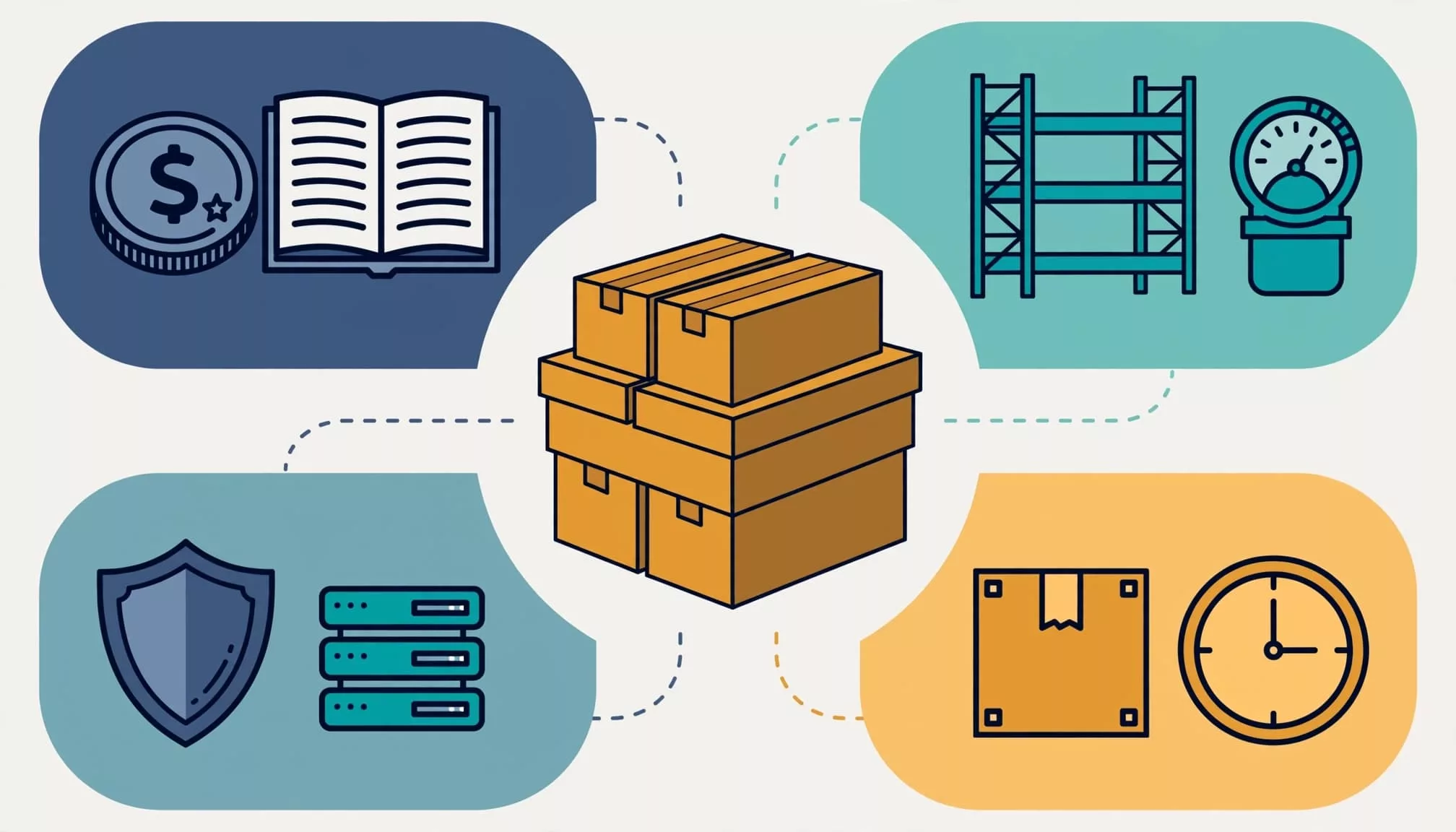
Inventory carrying cost, also called holding cost or the cost of holding inventory, covers four components. The carrying-cost component breakdown includes capital, services, storage, and inventory risk. Together, these categories make up annual inventory holding costs.
Capital costs
Capital cost is the financing expense or opportunity cost of money committed to inventory. Purchase price establishes the amount invested; it shouldn’t become a second annual holding expense.
Apply an appropriate annual financing or opportunity-cost rate to average inventory value. For borrowed funds, interest matters. For cash-funded stock, consider the return that cash could earn elsewhere. Don’t charge both against the same funds without a clear rationale.
Storage space costs
Include warehouse rent, utilities, lighting, heating, air conditioning, and physical handling associated with storing goods. For owned premises, include applicable occupancy expenses rather than treating mortgage principal repayment as an operating expense.
For owned storage equipment, include the annual depreciation attributable to inventory storage, rather than the full equipment purchase price.
Separate fixed commitments from variable charges. Reducing stock may lower occupied space immediately, but an unchanged warehouse lease won’t produce immediate cash savings.
Service costs
Service costs include inventory insurance, relevant taxes where applicable, inventory management software and IT infrastructure, and the staff time attributable to managing stored stock.
Higher inventory values can increase insurance exposure and premiums. Therefore, inventory turnover can affect service costs, although premiums won’t necessarily fall immediately after a stock reduction.
Risk costs
Include shrinkage caused by administrative errors, theft, employee theft, and damage, including unrecovered transit damage. Deterioration, expiry, obsolescence, and inventory-related markdown losses also belong here.
Count each loss once. An insurance reimbursement or supplier credit reduces the loss you actually bear.
Build Your Inventory Carrying Cost Calculator
Use one reporting year, currency, and product scope throughout. Match the inventory denominator to the stock covered by your annual expense inputs.
Establish average inventory at cost
For relatively stable stock, calculate:
Average stock value at cost = (Beginning inventory balance + Ending inventory balance) ÷ 2
Use average inventory at cost, not its expected selling price. For seasonal businesses, averaging regular monthly balances better captures stock accumulated before peak demand.
Reconcile physical and recorded balances first. Our guidance on improving ecommerce inventory accuracy explains why damaged goods and recording errors can distort the inventory base.
Add annual costs and calculate the percentage
In Excel or Google Sheets, enter these fields in column B.
| Cell | Input or result | Entry or formula |
|---|---|---|
| B2 | Average stock value at cost | Inventory at cost |
| B3 | Annual capital costs | Annual amount |
| B4 | Annual storage costs | Annual amount |
| B5 | Annual service costs | Annual amount |
| B6 | Annual risk costs | Annual amount |
| B7 | Total annual carrying costs | =SUM(B3:B6) |
| B8 | Carrying cost percentage | =B7/B2 |
Format B8 as a percentage. Leave it blank when the average stock balance is zero because division by zero produces no meaningful rate.
The carrying-cost percentage formula is annual holding costs divided by average inventory at cost, multiplied by 100. Spreadsheet percentage formatting performs the final display conversion.
Allocate shared expenses only to the inventory activity they support. Exclude advertising, payment fees, and customer delivery charges from this holding-cost calculation.
Worked Example: $500,000 in Average Inventory
Eazystock’s example uses $500,000 in average inventory and $125,000 in annual holding costs.
Here is the calculation using those figures.
| Calculator field | Amount |
|---|---|
| Average inventory value | $500,000 |
| Total annual carrying costs | $125,000 |
| Calculation | $125,000 ÷ $500,000 × 100 |
| Annual carrying-cost percentage | 25% |
The business spends 25 cents annually holding each dollar of average inventory. That percentage describes the stock investment, not a percentage of sales revenue.
Because the example provides only aggregate holding costs, it doesn’t establish how much belongs to capital, storage, services, or risk. Your calculator needs those underlying inputs from your own records.
Use a second view to distinguish paid expenses from opportunity costs. The complete economic calculation helps purchasing decisions, while the cash-expense view supports budgeting and monitoring cash flow.
A lower inventory balance releases working capital, but it doesn’t automatically reduce every expense included in the carrying-cost rate.
What Is a Typical Carrying-Cost Percentage?
Eazystock cites 20% to 30% of inventory value annually. Flowspace gives a broader lower boundary of 15% to 30%, while the holding-cost tutorial cites 20% to 35%.
These are reference ranges, not a universal target or a dated market average. Different definitions also explain some variation: a calculation excluding opportunity cost won’t compare fairly with one including it.
Your product mix matters. Bulky goods need more warehouse space, while short-lived products face greater obsolescence exposure. Financing terms also change the capital component.
Compare your rate with prior periods using the same definitions. Then inspect the four components separately. A rising percentage could reflect expensive financing, weaker turnover, higher storage charges, or a smaller inventory denominator.
NetSuite’s inventory carrying-cost guide provides additional context for interpreting holding expenses.
Use Carrying Cost for Purchasing and Pricing
A carrying-cost percentage becomes useful when it changes a buying decision. Review it alongside demand, supplier lead times, and the time products remain unsold.
Balance holding costs against ordering costs
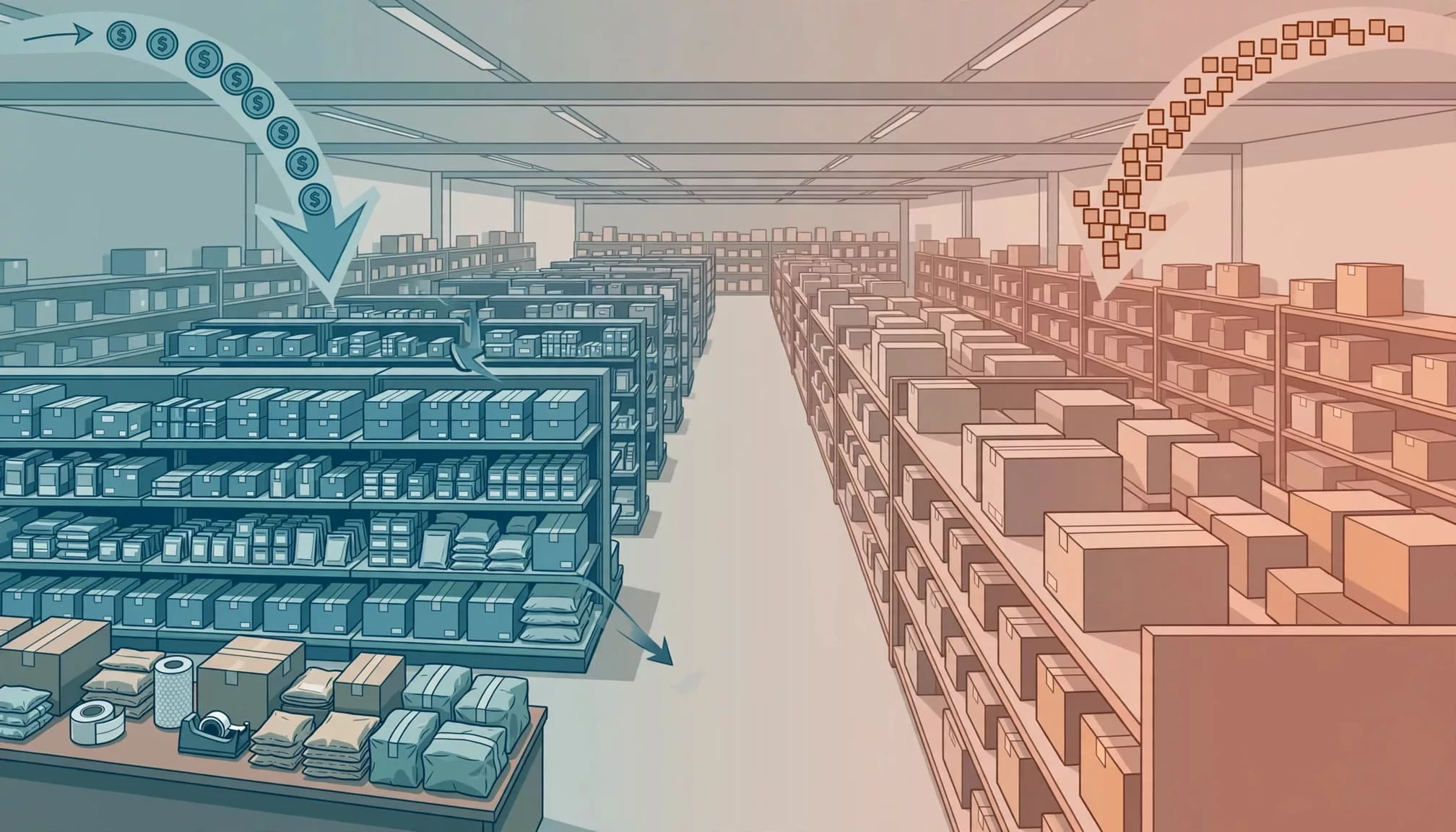
An ordering cost is incurred when you place and receive a purchase. Carrying costs accumulate while you retain inventory.
Smaller, more frequent orders can reduce average stock, but purchasing administration and freight may increase. Conversely, a supplier discount can disappear once extra storage, financing, and leftover-stock exposure enter the calculation.
Economic order quantity, or EOQ, balances ordering and holding costs under simplified demand assumptions. The holding-cost spreadsheet tutorial connects the holding-cost calculation with this purchasing trade-off.
Use our GMROI calculator alongside carrying cost to assess the gross profit generated by your inventory investment.
Assess pricing against time in stock
Don’t add the annual carrying-cost percentage directly to every selling price. A product held briefly and one stored for a year create different holding burdens.
Instead, include expected holding exposure in your profitability review. Compare net selling revenue with product cost, selling expenses, and the inventory costs needed to support that sale.
Our contribution margin calculator helps separate order-level variable costs. Keep fixed warehouse expenses visible in the broader profit model so you don’t deduct them twice.
Reduce Holding Costs Without Creating Stockouts
Eazystock describes controlled inventory reductions of 10% to 30% as a way to lower carrying costs. The savings depend on which expenses actually change, so avoid applying that reduction blindly across your catalog.
Improve forecasting and replenishment timing
Use demand forecasting by SKU and season, then review safety stock against demand variability and supplier reliability. ABC classification helps prioritize valuable or operationally important items.
Set a reorder point for each SKU rather than applying one buffer to every product. Compare triggers with sellable on-hand stock plus outstanding inbound units, less unfulfilled commitments, without subtracting commitments twice.
Also consider delivery dates. Inbound stock arriving after demand peaks won’t protect availability during the selling window.
Compare demand forecasting with actual sales before automating replenishment. Begin only after those inputs are dependable. Near season-end, stop automatic orders when another delivery would arrive too late to sell.
Address slow stock and prevent avoidable losses
Review slow-moving stock and obsolete stock before placing another purchase. However, weak sales can reflect poor visibility or inaccurate availability, so investigate before marking products down.
Improve merchandising or transfer stock between locations where practical. Then consider markdowns when their expected recovery exceeds the benefit of continuing to hold the goods.
Shorter supplier lead times can reduce required buffers. Meanwhile, reliable receiving records, inspected returns, and appropriate stock rotation help prevent damage, expiry, and phantom inventory.
Frequently Asked Questions
Should insurance sit under storage or service costs?
Insurance belongs under service costs in the four-component model. However, a warehouse invoice may bundle it with storage.
Record the insurance expense once, in a consistent category. The total matters more than moving an unchanged charge between headings.
Is the inventory purchase price an annual carrying expense?
Purchase price is the basis of the inventory investment. The capital carrying expense is the financing or opportunity cost of keeping that money committed.
Adding the full inventory purchase value to annual holding expenses would overstate carrying cost and confuse it with product acquisition cost.
Does faster inventory turnover always improve profitability?
Faster turnover usually reduces time in storage, but lower stock can also cause missed sales. More frequent replenishment may increase ordering expenses.
Read turnover beside availability, gross profit, and carrying costs. A smaller inventory balance helps only when the overall commercial result improves.
Make Inventory Earn Its Keep
A useful carrying-cost calculation captures the full cost of holding stock, including the capital expense that never appears on a warehouse invoice. Keep the inventory base and annual expenses consistent.
Then use the result to challenge purchase quantities, replenishment timing, and slow-stock decisions. Lower holding costs matter most when you preserve profitable sales and release cash you can use elsewhere.