

A return marked “defective” can point to a broken product, confusing setup instructions, or damage during delivery. Treating those explanations alike sends your team toward the wrong fix.
Useful analysis of ecommerce return reasons separates customer-reported problems from confirmed causes, then connects each cause to an owner and action. Your storewide return rate shows the scale of the problem, but SKU-level evidence shows where to intervene.
Start by preserving the customer’s account in the return data, and treat ecommerce return reasons as clues rather than diagnoses.
Key Takeaways
- Store the customer’s reason, verified cause, requested remedy, and final resolution separately.
- Compare SKU and category results using consistent denominators and equally mature delivery cohorts.
- Assign confirmed problems to product, merchandising, packaging, or fulfillment owners, then measure the change.
Separate Customer Reasons From Verified Root Causes
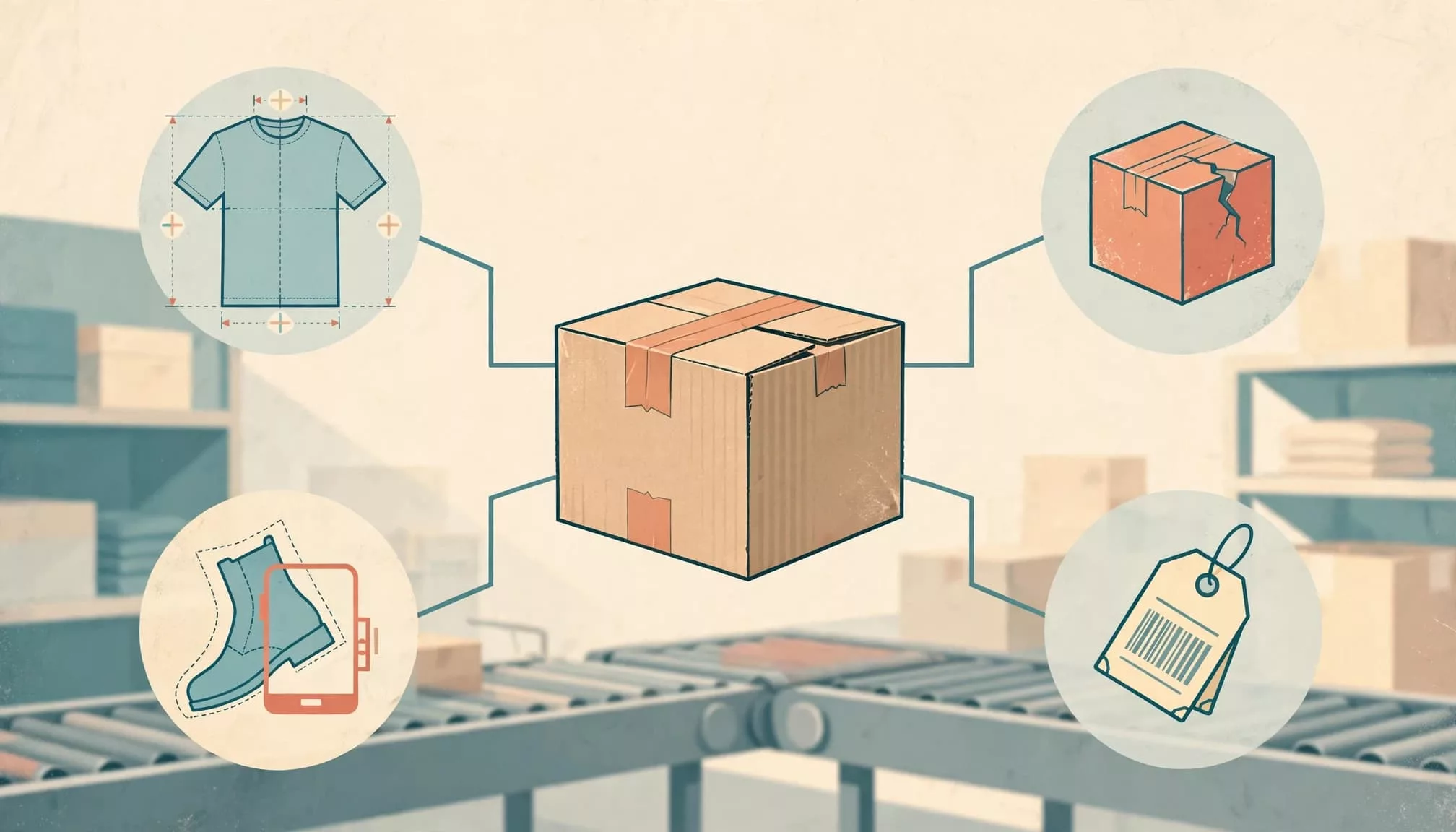
Preserve the customer’s account
The selected reason describes the customer’s experience. “Wrong item” could mean a picking error, a mislabeled variant, or confusing product imagery.
Record that reason against the affected order line. Keep the requested exchange or refund separate from the eventual outcome. An unavailable replacement can turn an exchange request into a refund without changing why the customer returned it.
Our ecommerce support ticket taxonomy follows this separation between customer intent and resolution.
Add evidence without overwriting it
Create a separate root-cause field with states such as suspected, confirmed, and unresolved. Link inspection findings, photographs, pick scans, and relevant support messages.
A warehouse inspection might confirm transit damage while the customer selected “defective.” Preserve both records.
A reason code describes a reported problem. A verified cause requires evidence, and the two fields can legitimately disagree.
Also store the cause’s owner and confirmation date so later reports distinguish investigations from completed diagnoses.
Improve Return Reason Codes at Collection
Use plain-language choices that lead to different actions. Separate “too small” from “too large,” damage from functional failure, and wrong item from missing item.
Prefill order and product details. Ask conditional follow-up questions only when useful, make optional fields obvious, and preserve answers after submission errors. Don’t collect a shipping address before a service requires it.
Track missing reasons and “other” selections. If customers repeatedly describe the same issue in free text, consider a dedicated code.
A single “damaged or defective” code is too broad. Distinguish transit damage from functional failure so each record reaches the right investigation.
Use reasons to route service, not automatically reject it.
| Customer-stated reason | Initial service route | Investigation owner |
|---|---|---|
| Size or fit | Offer an eligible exchange or refund | Product |
| Description mismatch | Refund or suitable replacement | Merchandising |
| Arrived damaged | Replacement or refund, plus carrier-claim assessment | Packaging and fulfillment |
| Wrong item | Correct shipment or refund | Fulfillment |
| Repeated inconsistent claims | Human review without assuming fraud | Returns operations |
An exchange should remain a choice. Investigation shouldn’t become an excuse to delay a refund the customer is entitled to receive.
Product and Merchandising Fixes by Return Reason
Benchmarks describe different populations. A percentage of surveyed shoppers isn’t equivalent to a percentage of returned units.
Size and fit need variant-level analysis
Claimlane attributes 40% to 50% of apparel and footwear returns to fit. Shopify/DealNews reports fit problems among 65% of online shoppers who had returned purchases, a different denominator.
Inspect size-specific return incidence by SKU, garment measurements, supplier lots, and comments. Product teams should address inconsistent grading or construction. Merchandising should publish a usable size chart with garment measurements and explain whether an item runs small or large.
Capital One Shopping’s retail return statistics group sizing, fit, and color at 45% of returns, damage at 16%, and inaccurate descriptions at 14%. Those broader groupings shouldn’t replace your category-specific taxonomy.
Description and color mismatches need content fixes
Invesp’s ecommerce return statistics attribute 23% of returns to receiving the wrong item and 22% to products looking different online.
For a product description mismatch, compare the purchased variant with its images, dimensions, included accessories, and compatibility claims. Correct the source product data, not only the storefront copy.
Threekit attributes 15% of home decor ecommerce returns to color mismatch. Show contextual and detail product photos, while acknowledging that screens can’t guarantee identical color.
For beauty, separate shade mismatch, unwanted texture, adverse reactions, and damaged seals. Shade information belongs to merchandising; a reported reaction needs an appropriate safety escalation. Combining these reasons hides different responsibilities.
Electronics Need Testing Before a Defect Label
Historical Accenture research, summarized in Corso’s category-specific return analysis, classified 68% of consumer electronics returns as “no trouble found” and 27% as buyer’s remorse.
Together, those classifications accounted for 95%, rather than confirmed product defects. However, “no trouble found” doesn’t establish that the customer’s problem never occurred.
Record the test procedure, accessories used, firmware, and whether the reported conditions could be reproduced. A passed power-on test doesn’t resolve an intermittent connection complaint.
Offer useful setup support without making troubleshooting a barrier to an eligible return. Product teams can then distinguish reliability problems from compatibility gaps or missing instructions.
Fulfillment Fixes for Damage, Wrong Items, and Delays

Separate transit damage from manufacturing defects
Bizrate Insights reports damage or defects as a leading return reason for 42% of respondents; Shopify/DealNews reports 56%. These survey figures aren’t warehouse defect rates.
Compare confirmed damage by SKU, packaging revision, carrier, service, and shipment route. Photograph the product and packaging condition where appropriate.
Threekit attributes roughly 20% of furniture returns to shipping damage and 40% to assembly and delivery issues. Keep those categories separate: broken panels, missing hardware, and an inaccessible delivery location require different fixes.
Packaging teams should test revised protection and carton sizing. Product teams own manufacturing faults, while warehouse operations manage handling controls and carrier claims.
Trace picking errors and missed delivery promises
For wrong item claims, compare order lines, barcode scans, packing records, and returned-item identity. Check bin labels and look-alike variants before blaming individual pickers.
Claimlane attributes roughly 6% to 8% of returns to late delivery. Separate dispatch delays from carrier delays and inaccurate delivery promises on the storefront.
Dispatch operations can improve dispatch controls. Merchandising and checkout teams should correct misleading delivery estimates. Report each issue against relevant shipped volume, because higher-volume routes naturally generate more claims.
Change of Mind, Bracketing, and Return Abuse
Expectation management can reduce avoidable regret
Claimlane places returns for a change of mind around 10% to 15%; Shopify/DealNews reports 11%. Clear product information and consistent return policy wording help customers make informed decisions and reduce regret after a change of mind.
Keep final-sale language aligned across product pages, checkout, confirmation emails, and support. A later confirmation can’t repair a restriction hidden before purchase.
Bracketing means ordering alternatives and returning unwanted options. For bracketing, Claimlane reports that 58% to 63% of online apparel shoppers admit ordering multiple sizes; Shopify, citing NRF, reports the practice among half of Gen Z shoppers. Analyze bracketing patterns across linked purchases before treating each fit return as independent dissatisfaction.
Repeated returns warrant proportionate review
Wardrobing means buying an item for an occasion, using it, then returning it. CNBC reported that 56% of surveyed consumers admitted the practice. Review suspected wardrobing claims alongside shipment evidence and inspection results.
Published return fraud estimates differ: NRF reports 9%, Appriss reports 15.14%, and Signifyd reports 11% of 2025 online returns as abusive. Their populations and definitions differ, so don’t average them.
Review repeated damage or wrong-item claims alongside shipment evidence and inspection results. Return frequency alone doesn’t prove dishonesty, especially when a recurring fulfillment fault could explain the pattern.
Measure SKU Patterns With a Repeatable Workflow
Define comparable metrics
NRF’s 2025 Retail Returns Landscape projected $849.9 billion in returns, with 19.3% of online sales returned versus 15.8% across retail.
Those sales-value benchmarks differ from unit-based operational metrics. Define unit return rate as returned units divided by delivered units from the same cohort.
Also track reason-specific incidence, verified-cause share, unresolved-cause share, and refund-stage elapsed time. Keep return requests separate from items received.
A blended return rate can conceal SKUs above 40%. Always display sample counts beside rates. For low-volume SKUs, use confidence intervals and repeated cohorts rather than reacting to one percentage. Safety concerns require immediate investigation regardless of sample size.
Run the same analysis cycle
- Join return data across order lines, delivery records, return requests, inspections, and refund events using stable identifiers.
- Compare equally mature cohorts by SKU, category, supplier lot, carrier, fulfillment location, and packaging version.
- Review high-volume causes and unusually high incidence, then assign an owner, intervention, and success measure.
- Compare post-change cohorts after equivalent elapsed time, including contribution, support contacts, and unresolved cases.
Prioritize preventable losses using verified volume and recoverable contribution. Our guidance on ecommerce A/B testing guardrails includes return costs alongside conversion results.
Declare when costs enter reporting, whether at request, receipt, or refund. Otherwise, timing differences can create a false improvement.
Refund Timing Can Prevent a Payment Dispute
Customers need the latest verified refund event, amount, and next step. Separate merchant processing, payment-provider acceptance, and bank posting instead of presenting them as one completed action.
Chargebackgurus estimates that chargeback costs can exceed twice the original purchase amount once fees and other costs are included. Monitor unresolved cases alongside return rates and payment disputes.
Under the Fair Credit Billing Act, issuers generally must acknowledge qualifying written billing-error notices within 30 days, unless already resolved. Resolution must occur within two billing cycles, no longer than 90 days.
The seven-business-day rule concerns refunds of eligible credit balances after a written request. These are issuer obligations, not a universal seven-day merchant return deadline.
Common Questions About Ecommerce Return Reasons
What is a valid reason for a return?
Damage, defects, wrong items, description mismatches, and fit problems are common legitimate reasons. Change of mind can also qualify under the applicable policy or consumer law.
Choose the truthful reason, including on Amazon. Describe the affected item and problem rather than inventing an excuse.
How should merchants handle repeated damage claims?
Review each claim against packaging condition, shipment records, item identity, and previous confirmed causes. Repeated claims justify human investigation, but they can also expose a persistent operational problem. Keep the customer informed while resolving eligible claims.
Conclusion: Give Every Confirmed Cause an Owner
Better return analysis connects the customer’s account to evidence and a specific corrective action. Keep reason codes useful, cohorts comparable, and unresolved causes visible.
Product, merchandising, packaging, and fulfillment teams should each own the problems they can change. Measure success through fewer preventable returns, without making legitimate returns harder.