

In 2026, ecommerce competition is reaching new heights as technology rapidly evolves and consumer expectations continue to rise. To thrive in this dynamic environment, mastering ecommerce optimisation is essential for any online business aiming to stay ahead.
This article delivers 11 actionable tips designed to help your store increase conversions, build loyalty, and outperform the competition. You will discover innovative strategies that cover user experience, artificial intelligence, mobile-first design, conversion rate optimisation, and advanced analytics.
Ready to future-proof your ecommerce business? Explore these proven tactics and start driving measurable growth in the ever-changing digital marketplace.
The New Landscape of Ecommerce Optimisation in 2026
The ecommerce optimisation landscape in 2026 is evolving at a rapid pace. Success now depends on understanding not only what consumers want, but also how technology, data, accessibility, and sustainability shape expectations. Let’s explore the key trends redefining how online stores compete and grow.

Shifting Consumer Behaviors and Expectations
Mobile and voice shopping are now mainstream, with over 70 percent of ecommerce traffic coming from mobile. Shoppers demand fast, personalized, and seamless experiences across devices. In fact, 80 percent expect tailored interactions and instant support from AI chatbots or live agents. Buyers often start on one device and finish on another, making cross-device consistency a must for ecommerce optimisation.
Top brands use AI-driven recommendations to boost conversions and engagement. For a deeper dive into how AI shapes these experiences, see AI-powered personalization in ecommerce. Meeting these new expectations is essential for staying competitive.
Emerging Technologies Transforming Ecommerce
Cutting-edge technologies are redefining ecommerce optimisation. AI powers dynamic pricing and real-time product recommendations. Augmented and virtual reality enable immersive product visualization, with Shopify reporting up to 94 percent higher conversion rates when AR is used. Automation streamlines marketing, fulfillment, and customer service, while blockchain ensures secure, transparent transactions.
Retailers leveraging AI chatbots have reduced cart abandonment by 20 percent. Keeping pace with these technologies is no longer optional for ecommerce optimisation; it’s the new standard.
The Critical Role of Data and Analytics
Advanced analytics tools now drive every aspect of ecommerce optimisation. Real-time data enables agile decision-making, from tracking KPIs like Average Order Value and Revenue Per Visitor to monitoring conversion rates. Segmentation based on customer behavior allows for hyper-targeted campaigns and personalized offers.
Brands using analytics can identify high-value segments and nurture them effectively. This data-first approach ensures strategies are always evolving to maximize ecommerce optimisation and ROI.
The Importance of Accessibility and Inclusivity
Accessible ecommerce design is both a legal requirement and a strategic advantage. Accessibility features like alt text, clear color contrast, and keyboard navigation benefit all users and improve SEO. Ecommerce optimisation prioritizing inclusivity expands your audience and increases sales.
For example, sites improving accessibility have seen up to 15 percent sales growth. Tactics like screen reader support and accessible forms make online shopping smoother for everyone, which is vital for ecommerce optimisation in 2026.
Sustainability and Ethical Shopping Trends
Sustainability is now a defining factor in ecommerce optimisation. Shoppers increasingly prefer eco-friendly brands and transparent supply chains. Green logistics, recyclable packaging, and visible sustainability badges influence purchasing decisions.
Sixty percent of consumers are more likely to buy from sustainable brands. Highlighting environmental initiatives and ethical sourcing builds trust and positions your store for success as ecommerce optimisation shifts toward responsible practices.
11 Smart Ecommerce Optimisation Tips for Success in 2026
Staying ahead in ecommerce optimisation requires a proactive, multifaceted approach. Here are 11 expert tips to help your online store excel, boost conversions, and future-proof your business for 2026.

1. Optimize for Lightning-Fast Mobile Experiences
In 2026, mobile-first ecommerce optimisation is non-negotiable. With over 70 percent of sales happening on mobile, your store must deliver a seamless experience. Start by implementing responsive layouts and adaptive images that adjust to every device.
Utilize Mobile-first ecommerce design tips to ensure navigation is intuitive and touch-friendly. Accelerate performance using AMP for product pages and blogs. Prioritize Core Web Vitals—LCP, FID, and CLS—to guarantee rapid load times.
Integrate mobile payment solutions like Apple Pay and Google Pay for frictionless checkout. Test your site across devices and operating systems to catch inconsistencies. Remember, 40 percent of shoppers will abandon a site if it loads in over three seconds.
Sites that reduce mobile load time below two seconds see 50 percent higher engagement. Fast, responsive mobile design is foundational for ecommerce optimisation and customer retention.
2. Leverage AI-Driven Personalization Engines
AI is transforming ecommerce optimisation by delivering tailored experiences in real time. Use AI to segment users by behavior, location, and purchase history, enabling dynamic recommendations and content.
Personalize homepages, product sorting, and upsell modules to match user intent. Incorporate predictive analytics for smarter inventory and promotional decisions. AI chatbots can provide immediate, customized support, increasing satisfaction.
Brands like Amazon attribute 35 percent of their sales to AI recommendations. Extend personalization to email campaigns and on-site messaging for deeper engagement. As ecommerce optimisation advances, leveraging AI ensures you meet rising consumer expectations for relevance and speed.
Invest in AI-driven tools to stay competitive and drive higher conversion rates through smarter, individualized experiences.
3. Streamline Checkout to Reduce Cart Abandonment
A streamlined checkout process is critical for ecommerce optimisation. Simplify forms by minimizing required fields and always offer a guest checkout option. Use progress indicators and keep cart contents visible throughout.
Integrate one-click payment solutions like Shop Pay or PayPal One Touch to speed up transactions. Exit-intent popups with incentives—such as discounts or free shipping—can recover would-be dropouts. Automated email and SMS reminders effectively bring shoppers back.
Displaying trust badges and secure payment icons alleviates security concerns. Brands that optimize checkout see up to 30 percent fewer abandoned carts. Consistently review analytics to spot and address friction points.
A frictionless, secure checkout is a cornerstone of ecommerce optimisation and revenue growth.
4. Invest in High-Impact Product Photography & Video
Visual content is a powerful driver in ecommerce optimisation. Use high-resolution, multi-angle images and 360-degree views to showcase products authentically. Short explainer videos and AR previews help customers visualize items in real life.
Incorporate user-generated photos and reviews to build trust. Maintain consistent lighting and backgrounds to reinforce your brand identity. Sites with interactive product media report 25 percent higher conversion rates.
Optimize images for fast loading and include descriptive alt text for accessibility and SEO. Lifestyle shots help customers imagine the product in their own environment. Prioritizing visual excellence is essential for modern ecommerce optimisation.
5. Deploy Advanced Email & SMS Automation
Automation is crucial for effective ecommerce optimisation in 2026. Implement automated email sequences for welcomes, post-purchase follow-ups, win-back campaigns, and abandoned carts. Segment your audience for targeted messaging that resonates.
Personalize subject lines and content using dynamic fields. A/B test your campaigns to optimize open and click-through rates. Integrate SMS for urgent offers and reminders.
Automated emails generate 320 percent more revenue than generic blasts. Use analytics dashboards to monitor performance and refine your strategy. Advanced automation drives sustained engagement and higher conversions, making it a vital part of ecommerce optimisation.
6. Utilize Data-Driven Analytics for Continuous Improvement
Continuous improvement is at the heart of ecommerce optimisation. Use tools like Google Analytics 4, Hotjar, and e-commerce dashboards to monitor key performance metrics: conversion rate, AOV, RPV, bounce rate, and traffic sources.
Analyze heatmaps and session recordings to uncover UX bottlenecks. Regularly review funnel performance and drop-off points to pinpoint where users disengage. Brands that act on analytics insights often see a 20 percent lift in conversions.
Set up custom reports and alerts for anomalies. Use findings to inform A/B tests and site updates. A data-driven mindset ensures your ecommerce optimisation strategy evolves with shopper behaviors.
7. Enhance User Experience (UX) with Intuitive Navigation
Effective navigation is essential for ecommerce optimisation. Design clear, logical menus and use breadcrumb navigation to help users orient themselves. Prominent search bars with predictive suggestions and robust filters empower customers to find products quickly.
Consistent UI elements and branding across all pages reinforce trust. Sticky calls-to-action and easy access to the cart and support enhance usability. Sites that improve navigation see lower bounce rates and longer session times.
Accessibility features like keyboard navigation and screen reader support are critical. Regularly test navigation with real users to gather actionable feedback. A seamless UX is a key differentiator in ecommerce optimisation.
8. Build Trust with Social Proof and Transparent Policies
Trust is a cornerstone of ecommerce optimisation. Display verified customer reviews, ratings, and testimonials to boost credibility. Highlight user-generated content and social media mentions to foster community.
Showcase trust badges—SSL, payment security, and money-back guarantees—prominently. Provide transparent shipping, return, and privacy policies so customers know what to expect.
Adding reviews can increase conversion rates by 18 percent. Use FOMO tactics like low stock alerts and live purchase notifications to prompt timely action. Featuring credible partnerships and certifications further enhances trust, strengthening your ecommerce optimisation efforts.
9. Implement Smart Upselling and Cross-Selling Strategies
Upselling and cross-selling are proven tactics in ecommerce optimisation. Use AI to power product bundles and “frequently bought together” modules. Offer personalized upsell opportunities on product and cart pages.
Engage customers with post-purchase upsells via thank you pages and follow-up emails. Upselling can boost average order value by up to 30 percent. Social proof helps justify premium upgrades and encourages higher spending.
Limit upsell choices to avoid overwhelming customers. Offer dynamic discounts for bundled purchases. Smart upselling and cross-selling strategies are essential components of successful ecommerce optimisation.
10. Prioritize Site Accessibility and Inclusive Design
Accessibility is a non-negotiable aspect of ecommerce optimisation. Follow WCAG 2.2 standards, ensuring proper color contrast, alt text for images, and keyboard navigation. Allow users to resize text and choose readable fonts for clarity.
Ensure voice search and screen reader compatibility. Accessible sites can reach 15 percent more potential customers. Test your store with accessibility tools and real user groups to identify and resolve issues.
Include an accessibility statement and provide a clear support contact for assistance. Regular audits help maintain compliance. Prioritizing inclusive design broadens your market and enhances your ecommerce optimisation strategy.
11. Embrace Sustainable Practices and Ethical Branding
Sustainability is a growing priority in ecommerce optimisation. Offer eco-friendly products and packaging options, and communicate your efforts with badges, certificates, and compelling stories.
Share transparent supply chain details and ethical sourcing practices. Sixty percent of consumers prefer to buy from sustainable brands. Provide carbon-neutral shipping and green delivery options to appeal to conscious buyers.
Feature impact reports and charity partnerships to demonstrate your commitment. Educate customers about your environmental initiatives. Ethical branding not only builds trust but also future-proofs your ecommerce optimisation approach.
Conversion Rate Optimization: Metrics, Testing, and Iteration
Optimising your ecommerce store for higher conversions in 2026 means focusing on the right data, ongoing testing, and adapting based on customer input. Ecommerce optimisation is no longer a one-time project, but a continuous cycle of measurement, experimentation, and refinement. Let us break down the four pillars that drive sustained growth.
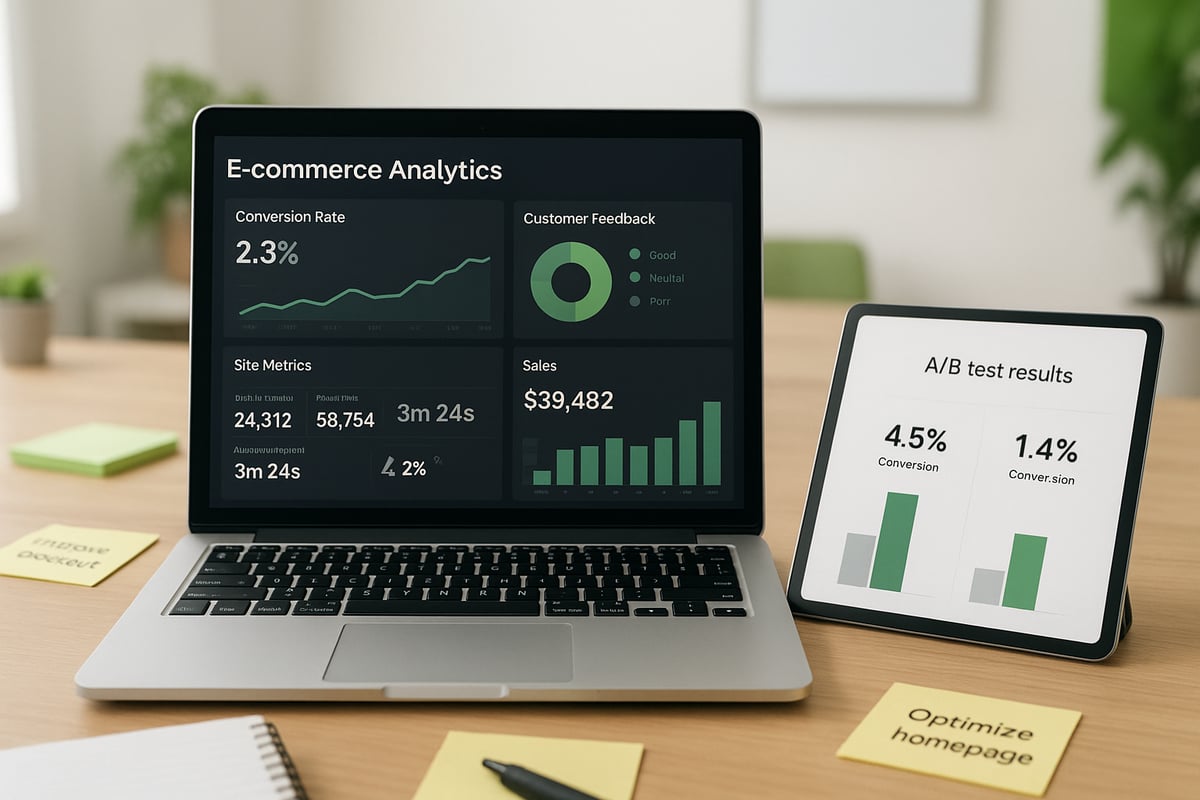
Key Ecommerce Metrics to Track in 2026
Tracking the right metrics is foundational for ecommerce optimisation. Focus on conversion rate, average order value (AOV), revenue per visitor (RPV), customer lifetime value (CLV), and bounce rate. These indicators reveal how effectively your site turns visitors into buyers and identifies bottlenecks in the customer journey.
Micro-conversions, such as newsletter signups and add-to-cart actions, are also essential for understanding user intent. According to Ecommerce conversion rate statistics, the global ecommerce conversion rate reached 3.34% in 2025, highlighting the importance of ongoing optimisation. Cohort analysis further helps you segment and understand repeat buyers, shaping retention strategies.
The Power of A/B and Multivariate Testing
Experimentation fuels ecommerce optimisation by revealing what truly resonates with your audience. Use A/B testing to compare headlines, calls to action, product images, and checkout flows. Multivariate testing allows you to assess combinations of elements, such as layout and pricing.
Run controlled experiments on shipping offers or promotional banners, always using statistical significance to validate results. For example, A/B testing subject lines can increase open rates by 20%. For more structured strategies, explore Ecommerce conversion rate optimization to deepen your approach and stay competitive.
Continuous Improvement Through Iteration
Ecommerce optimisation thrives on regular review and incremental improvements. Analyse analytics and customer feedback to spot trends and challenges. Implement small changes, monitor their effects, and document results to build a culture of experimentation.
Teams that embrace iterative conversion rate optimisation see sustained growth and adaptability. Encourage collaboration between marketing, design, and development, ensuring that every update is data-driven and customer-focused.
Leveraging Customer Feedback for Optimization
Your customers are a goldmine of insights for ecommerce optimisation. Collect feedback through reviews, surveys, and support interactions to uncover pain points and opportunities. Use these insights to prioritise site updates, product enhancements, or service adjustments.
Close the feedback loop by communicating improvements back to customers, which increases loyalty and retention. Brands that act on customer input create a more engaging, responsive shopping experience, driving measurable results in conversion and satisfaction.
Future-Proofing Your Ecommerce Store for 2026 and Beyond
The future of ecommerce optimisation is shaped by rapid innovation, shifting consumer habits, and an ever-expanding global market. In fact, projections show global ecommerce sales are expected to reach $6.88 trillion by 2026, making future-proof strategies essential for long-term growth. To stay ahead, retailers must rethink their approach to ecommerce optimisation with a focus on agility, technology, and customer-centricity. The following strategies will help your online store thrive in a dynamic digital landscape.

Integrating Omnichannel and Cross-Platform Experiences
Delivering seamless experiences across web, mobile, social, and even physical stores is now a cornerstone of ecommerce optimisation. Shoppers expect to move from browsing on a phone to purchasing on a laptop, or even picking up in-store, without friction. This requires unified customer profiles, synchronized inventory, and consistent branding. Brands embracing omnichannel strategies retain up to 89% of customers, highlighting the powerful impact of integrated touchpoints.
| Channel | Key Benefit | Example |
|---|---|---|
| Website | Full product catalog | Online exclusive deals |
| Mobile App | Push notifications | Mobile-only rewards |
| Social Commerce | Influencer engagement | In-app purchases |
| Physical Store | Personal assistance | Click-and-collect |
The right ecommerce optimisation approach ensures your store is prepared to meet customers wherever they are and however they choose to shop.
Preparing for AI, AR, and Voice Commerce
Emerging technologies are redefining ecommerce optimisation. Artificial intelligence powers personalized product recommendations and dynamic pricing, while augmented reality enables shoppers to visualize products in their space. Voice commerce, driven by smart speakers and assistants, is making purchasing even more convenient. Investing in platforms that support these technologies keeps your store adaptable and relevant. For example, AR features can drive conversion rates up to 94%, making them a strategic priority for future growth. Testing and iterating with these innovations ensures your ecommerce optimisation efforts remain on the cutting edge.
Adapting to Regulatory and Privacy Changes
Global data privacy regulations are evolving rapidly, affecting every aspect of ecommerce optimisation. Laws such as GDPR and CCPA require transparent data collection, explicit consent, and robust security measures. Staying updated is vital not only to avoid legal risks but also to build lasting trust with your audience. Implementing clear privacy policies and user-friendly consent mechanisms can differentiate your brand. Regular audits and compliance reviews ensure your ecommerce optimisation practices remain current and credible, fostering confidence among privacy-conscious shoppers.
Building a Resilient, Scalable Ecommerce Infrastructure
A robust infrastructure is the backbone of effective ecommerce optimisation. Cloud-based, modular platforms offer the resilience and flexibility needed to handle traffic surges and support business growth. Planning for scalability prevents downtime during major sales events and enables smooth expansion into new markets. Features like automated backups, real-time monitoring, and disaster recovery protocols are essential. Investing in a future-ready infrastructure guarantees your ecommerce optimisation strategy can withstand technological shifts and rising consumer demands.