

An online store generally must register for sales tax when it establishes a qualifying physical connection or crosses an economic nexus threshold in a state. Sales tax nexus is that connection, and it can create obligations even when you sell entirely online.
The difficult part is that states measure sales differently, and marketplace collection doesn’t always remove your responsibilities. To assess sales tax nexus, start with each state’s thresholds, then separate what creates nexus from who must collect the tax.
State-by-state economic nexus thresholds
Economic nexus rules apply to qualifying remote sellers. Streamlined Sales Tax’s remote-seller state guidance organizes the different state requirements.
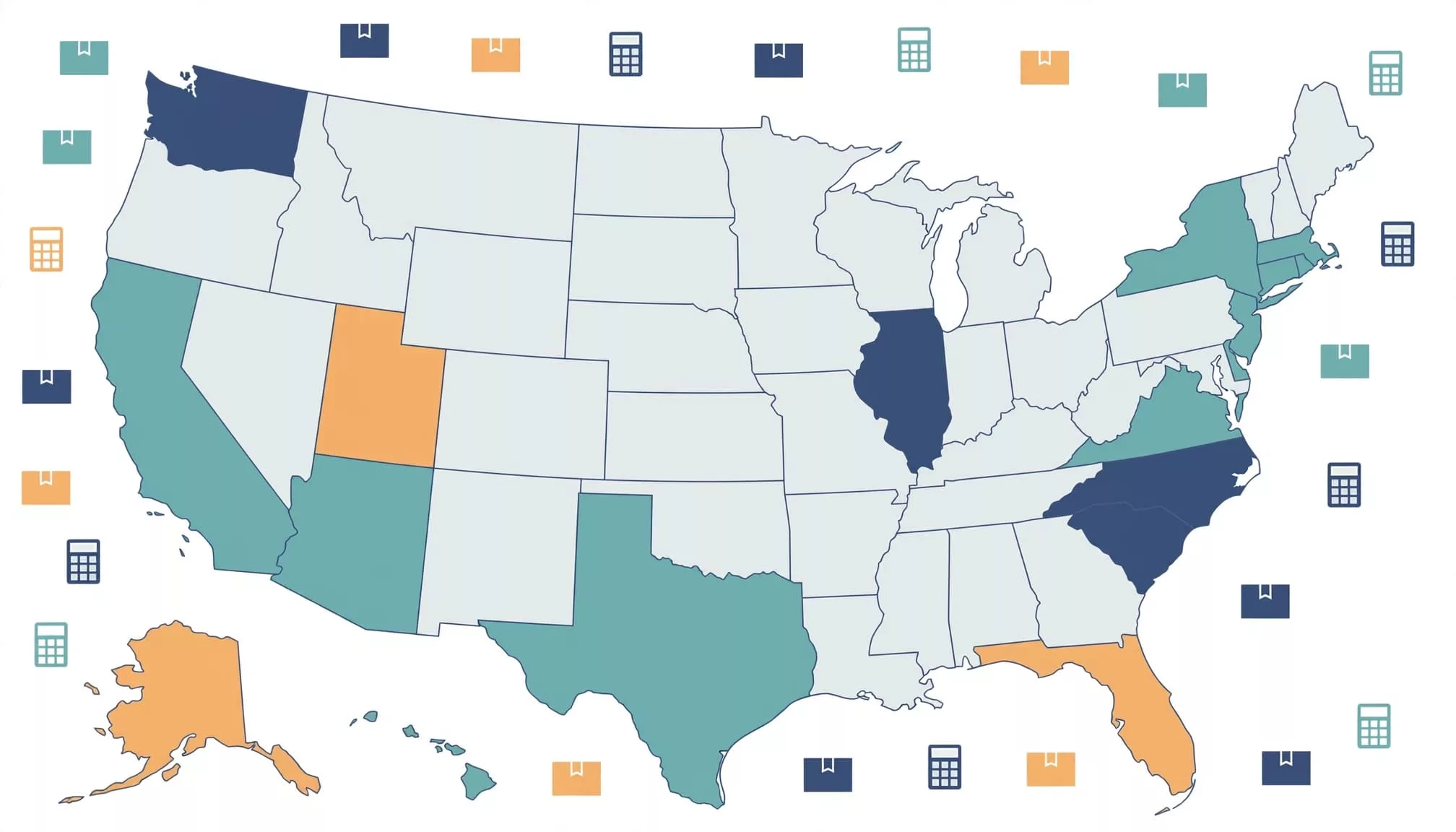
These selected states show why a single nationwide threshold won’t work.
| State | Economic nexus test | Measurement period |
|---|---|---|
| California | More than $500,000 in combined qualifying sales | Previous or current calendar year |
| Texas | $500,000 remote-seller safe-harbor threshold | Preceding 12 calendar months |
| New York | More than $500,000 and more than 100 sales | Preceding four sales-tax quarters |
| Alabama | More than $250,000 in qualifying direct retail sales, with no transaction test | Previous calendar year |
California and Texas share a headline dollar amount, but they use different measurement periods. New York requires both conditions, so passing its dollar threshold alone doesn’t satisfy its economic nexus test.
The commonly quoted standard is a $100,000 threshold or 200 transactions, with either condition triggering nexus only in states that use that structure. However, some states use sales-only tests, and the exact boundary can mean “more than” rather than “at least.”
Alaska, Delaware, Montana, New Hampshire and Oregon, often called the NOMAD states, have no statewide sales tax. That description doesn’t eliminate every local or business-tax obligation.
How physical and economic nexus differ
Physical presence creates a separate route to nexus
Physical nexus concerns your business’s actual presence in a state. Economic nexus concerns qualifying sales into that state without requiring physical presence.
Some states apply affiliate nexus if an in-state affiliate promotes or refers customers to a seller; tests vary by state.
For a small online store, the practical distinction matters immediately: falling below a remote-seller threshold doesn’t automatically excuse a business with physical nexus. Assess your existing operations separately from your interstate sales totals.
Your home-state obligations also deserve attention before expansion. A store shouldn’t treat the economic nexus table as a blanket exemption for its entire business.
Economic nexus reaches remote sellers
In South Dakota v. Wayfair, decided June 21, 2018, the Supreme Court allowed states to require certain sellers without physical presence to collect and remit sales tax.
That means a growing store can acquire obligations through customer sales alone. However, nationwide revenue doesn’t determine every state’s result. You measure the sales attributable to each destination under that state’s rules.
Also, transaction tests can affect lower-priced stores sooner than high-value sellers. Where either condition applies, modest revenue doesn’t prevent a transaction count from creating nexus.
Measure sales using each state’s rules
Calendar years and rolling periods behave differently
A calendar-year test measures sales within January through December. California considers the previous or current calendar year, so January 1 doesn’t necessarily remove an existing obligation.
Texas instead uses the preceding 12 calendar months. For a November 2026 review, that window covers November 2025 through October 2026. The next review drops November 2025 and adds November 2026.
Keep those calculations separate. A year-to-date dashboard alone can’t evaluate a rolling period correctly.
A January sales reset doesn’t erase nexus when the state’s test also includes the previous year.
California’s threshold illustrates the boundary: $500,000 doesn’t exceed $500,000, while $500,001 exceeds it by $1. That calculation addresses economic nexus only; a separate physical connection can change the result.
Gross sales and taxable sales aren’t interchangeable
States don’t all count the same revenue. Streamlined Sales Tax’s threshold terminology guide explains how gross, taxable and exempt sales affect the calculation.
Gross-sales measures can include transactions on which you collect no tax. Taxable-sales measures use a narrower base.
Wholesale sales need their own classification. A resale certificate documents a qualifying wholesale exemption, but it doesn’t automatically exclude that revenue from every nexus calculation.
Therefore, retain both the transaction’s tax treatment and its threshold treatment. One field labeled “tax exempt” can’t reliably answer both questions.
Marketplace sales change who collects
Platforms can collect without handling every obligation
Marketplace facilitator laws often require platforms such as Amazon, Etsy and eBay to collect and remit tax on covered transactions.
However, even when a marketplace facilitator collects tax, that doesn’t automatically settle your registration or reporting duties. Streamlined Sales Tax’s marketplace seller guidance distinguishes these responsibilities across states.
Your own storefront creates a separate collection question. Tax collected on an Amazon order doesn’t cover a taxable order placed directly through your Shopify or WooCommerce store.
Marketplace exclusions depend on the state
Alabama excludes qualifying marketplace sales when the participating marketplace collects Alabama tax. Its calculation also excludes qualifying wholesale resale sales.
Other states treat marketplace revenue differently, so don’t subtract all facilitated sales from every state’s report.
Keep marketplace-collected transactions identifiable rather than deleting them from your records. You need the original sales data to apply different state rules, reconcile platform reports and explain why your business didn’t collect tax on particular orders.
Monitor nexus across every sales channel
Use a state-level worksheet or tax-monitoring system that combines direct-store and marketplace transactions without counting the same order twice.
At minimum, retain the destination state, order date, transaction identifier, sales amount, exemption status and collection channel. Then apply each state’s measurement period and inclusions to that underlying data.
Your commerce and accounting records should drive the calculation. Marketing analytics can duplicate purchases, miss transactions or apply reporting adjustments that don’t match tax rules.
Reconcile imports using consistent transaction IDs. Also, keep refunds and cancellations distinguishable rather than silently rewriting the original order.
Review totals monthly as an operating routine, with more frequent alerts near a threshold. This is a monitoring practice, not a universal statutory review interval.
Assign one person responsibility for reviewing alerts and recording the next action. A notification without an owner can sit unread while sales continue.
For multistate stores, separate each state’s registration status, collection start date and filing obligations. One combined “tax enabled” setting can’t describe every state’s position.
Register, collect and remit after nexus starts
Crossing a threshold starts a sales tax compliance process. Confirm the required sales tax permit and collection date. Your ecommerce platform doesn’t complete registration for you.

- Establish the triggering date and applicable collection deadline. Preserve the report showing when the threshold was crossed. Texas requires collection no later than the first day of the fourth month after the crossing month.
- Register for the required sales tax permit, called a sales tax license or certificate in some states. Participating states offer a registration route through the Streamlined Sales Tax program.
- Configure collection for the required start date. Enter the registration details and classify products and exemptions correctly.
- Test checkout and order records. Review destination changes, exempt purchases and refunds using our online store launch checklist.
- Complete each required sales tax filing, remit tax and retain supporting records. Follow the schedule assigned to your account, including required zero returns.
The collection start date deserves its own task. Filing deadlines arrive later, so waiting for the first return can leave taxable orders uncollected.
Also, test what happens when a customer edits their shipping address. Our guide to checkout tax recalculation covers discrepancies between checkout totals and underlying tax inputs.
Archive permits, returns, payment confirmations, marketplace reports and exemption documentation together. These records explain both what you collected and why some transactions carried no seller-collected tax.
Key takeaways for growing stores
- Evaluate physical presence separately from remote-seller sales thresholds.
- Track each state’s qualifying revenue, transaction count and measurement period rather than relying on nationwide totals.
- Keep marketplace collection, seller registration and direct-store collection as separate responsibilities.
Sales tax nexus FAQ
What is Georgia’s economic nexus threshold?
Georgia’s Department of Revenue lists at least $100,000 in sales or more than 200 separate transactions as registration triggers. Its sales test refers to the last calendar year.
Marketplace sellers may exclude qualifying facilitated sales under Georgia’s guidance. Therefore, a combined channel revenue total needs classification before it can support the state’s nexus calculation.
As elsewhere, this remote-seller test doesn’t replace a separate assessment of physical presence.
What happens if a store doesn’t register?
Failing to register or collect can leave the seller responsible for unpaid tax, interest and applicable penalties. The missing collection doesn’t necessarily remove the underlying liability.
If you’ve already missed a required start date, preserve your historical sales records and separate marketplace-collected transactions from direct sales. A state-tax adviser can assess past exposure and disclosure options before you submit registrations.
Make nexus tracking part of store operations
Sales tax nexus depends on state-specific rules, your business’s connection to the state and the sales included in its calculation. A single revenue alert can’t capture all three.
Build state-level tracking into your routine, then connect each registration to a collection start date and filing process. That keeps sales growth tied to a clear operational response instead of an unresolved tax notification.