

A corrected product description can disappear during the next import if nobody knows which system has authority. Clear product data ownership gives each field an accountable decision-maker, an authoritative source, and a controlled path to publication.
Your PIM, ERP, and storefront may all hold the same value, but that doesn’t give every team permission to change it. The practical goal is field-level accountability, backed by approval rules and traceable updates.
Separate business responsibility from system location, then use data governance and data strategy to guide field-level decisions through publication.
Key Takeaways
- Assign each product field an accountable business owner, an authoritative source, permitted editors, and an approved publication route. A field’s location in a system does not determine who has authority to change it.
- Define each value’s scope, evidence, freshness expectations, validation rules, and escalation path. Distinguish contexts such as child SKU, market, currency, customer, and effective period.
- Resolve conflicting values by checking the same item and context, then correct the source record or transformation responsible for the error. Verify the approved value across downstream systems and customer-facing outputs.
- Match approvals and publication controls to the risk of each field. Bound exceptions with an approver, scope, reason, and expiry, and keep the matrix aligned with how teams actually work.
Separate Product Data Ownership From System Location
Assign people the decision rights
The business owner decides what a field means and approves its governing rules. A steward maintains records, investigates errors, and coordinates corrections. Editors make permitted changes, while approvers validate sensitive updates.
For example, product management can own technical accuracy while PIM administrators maintain attribute structures. Merchandising can own customer-facing descriptions without gaining authority over pressure ratings or safety claims.
Assign one accountable role for each field within its defined scope. Technical contributors can share responsibility for delivery, but conflicting business decisions need a named escalation owner. Integration teams shouldn’t have to choose which disputed specification is true.
Choose authority around your architecture
An authoritative system holds the approved value for a particular field. A storefront displays or transforms that value for a selling context.
PIM commonly manages enrichment, while ERP manages operational and commercial records. However, inventory authority may sit in a warehouse or order management system. Pricing may involve a dedicated engine or CPQ platform.
Document those differences rather than forcing every attribute into PIM or ERP. Even without a PIM, the same ownership rules apply to a commerce platform, supplier intake process, and controlled asset library. Authority depends on the approved workflow, not the system’s name.
A data mesh is an optional model for decentralized ownership, giving domains field-level decision rights. Centralized governance can still set shared identifiers, approval rules, and publication controls. Base the design on your actual data platform and data infrastructure.
Build a Field-Level Product Data Ownership Matrix
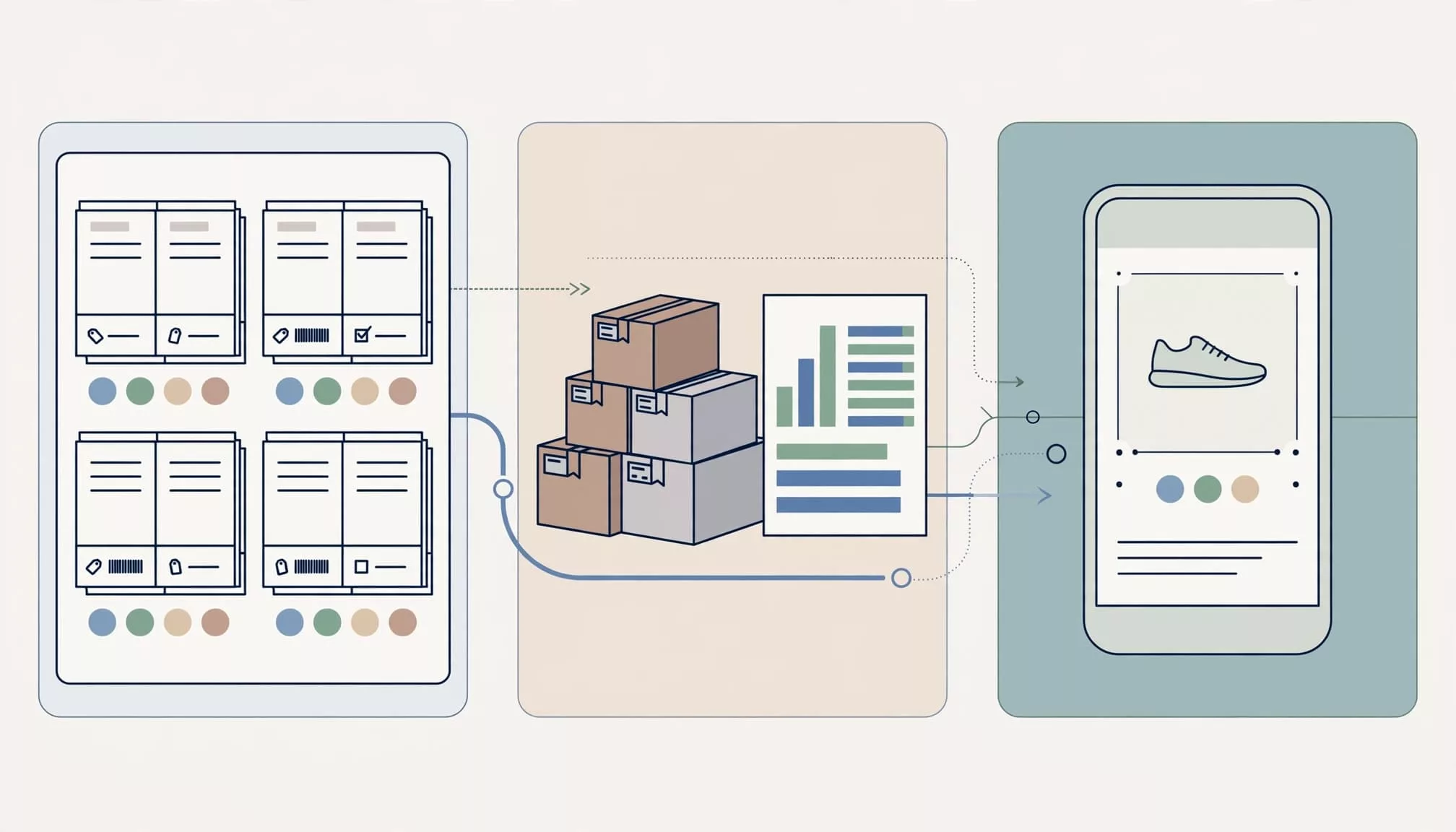
Use this starting matrix, then replace roles, systems, and publication routes with your actual operating model. The system-of-record column identifies authority, not every place holding a copy. The publication route shows how approved values reach a storefront or channel.
Use data stewardship to keep field definitions current, and metadata management to maintain ownership and source details in a data catalog.
| Field | Accountable business role | Typical system of record | Value creator | Permitted editor | Approval or control | Approved publication route |
|---|---|---|---|---|---|---|
| SKU and identifier mapping | Product master lead | ERP or master-data system | Product master team | Master-data steward | Controlled creation; stable cross-system mapping | Sync approved mappings to PIM and connected channels |
| Product descriptions | Content lead | PIM or governed catalog | Content team | Content team | Brand review; verify embedded technical claims | Publish approved content from PIM to the storefront or channel |
| Technical specifications | Product manager | PIM with verified engineering evidence | Product or engineering team | Product-data steward | Technical review before publication | Publish verified values through the approved PIM or channel workflow |
| Base and account pricing | Pricing lead | ERP or pricing engine | Pricing operations | Pricing operations | Validate customer, currency, and effective dates | Send approved prices from the pricing system to commerce channels |
| Available-to-sell inventory | Inventory operations lead | ERP, WMS, or OMS | Authorized operational process | Authorized operational process | Reconcile location, reservations, and freshness | Update storefront availability through the configured inventory feed |
| Images and documents | Creative operations lead | DAM or controlled asset library | Asset team | Asset team | Rights, revision, and product-match checks | Publish approved assets to PIM, storefront, or channel |
| Channel titles and translations | Channel or regional lead | PIM or channel-content repository | Channel content team | Channel content team | Market review; preserve approved facts | Publish approved content through the channel workflow |
| Promotional offers | Commercial lead | Promotion service or commerce platform | Authorized promotion team | Authorized promotion team | Discount approval and expiry controls | Activate the approved offer on the relevant storefront or channel |
PIM, ERP, and storefront teams may create, approve, or publish different fields. Define those responsibilities and routes for your architecture rather than assuming one system handles every step.
Split broad rows when decision rights differ. For images, creative operations may control visual standards while product management verifies the pictured variant.
Give parent records and child SKUs separate coverage where facts differ. Shared family descriptions don’t establish a child’s dimensions, price, or availability.
Add Scope, Freshness, and Evidence to Every Row
Define the exact value being governed
“Price” is too broad for an ownership contract. Distinguish list price, account price, promotional price, currency, tax treatment, and the offer shown at checkout.
Likewise, physical stock isn’t automatically available-to-sell inventory. Document the calculation, warehouse scope, reservation handling, and exclusions. Otherwise, teams may compare valid numbers that answer different questions.
Record whether an attribute belongs to the product family, child SKU, market, channel, or customer segment. Keep internal SKUs distinct from external identifiers. The GS1 GTIN standard identifies trade items; SKU mappings follow your catalog’s internal rules.
Track evidence and expected freshness
Use metadata management to record the proof source, update trigger, freshness expectation, validation rule, and escalation route. A technical specification needs evidence such as an approved manufacturer document, not merely a populated field.
Preserve the originating record and transformation history. If an integration converts a unit or derives availability, record that rule and its owner.
Price and inventory need tighter freshness controls than stable descriptive attributes. However, each team must agree on expectations its integrations can meet. Connect these rules to a product data completeness scorecard so missing evidence and stale values reach the responsible owner.
Data quality depends on accuracy, evidence, and freshness. A filled field can still be inaccurate or overdue for review.
Resolve Conflicting Values at Their Origin
Compare the same purchasable item
When systems disagree, first confirm that they describe the same child SKU, market, currency, customer context, and effective period. Parent-level comparisons can conceal variant errors.
For pricing, inspect account terms, promotion rules, currency handling, and the value actually used at checkout. For inventory, compare locations, reservations, sellable status, and synchronization timing.

Don’t declare the newest timestamp the winner. A recent storefront edit may have less authority than an approved source record. Conversely, a correct source value may reach shoppers through a broken transformation.
Correct the source or the transformation
Use the matrix to identify the accountable owner, then investigate the source record, evidence, integration mapping, data pipeline, and rendered output. The business owner approves the field’s meaning and value, while the integration or pipeline owner fixes transport, mapping, or transformation defects. Correct whichever part produced the error.
If authority itself is disputed, escalate to the named business decision-maker. Pause publication of the affected field or offer when the unresolved difference makes selling unsafe or misleading.
After correction, republish through the normal integration and compare downstream copies. Include feeds and structured data when they carry the same offer.
A storefront correction that the next import overwrites is a temporary exception, not a completed source correction.
For feed-related incidents, preventing product feed disapprovals requires checking the exact variant’s submitted data against its live offer. Close the incident only after those outputs agree with the approved source.
Route Approvals and Exceptions by Risk
Match review to the changed field
Routine copy edits shouldn’t wait for every stakeholder. Route reviews according to the attribute and the consequences of an error.
Brand reviewers can approve tone and naming. Product managers verify specifications and compatibility. Pricing owners approve commercial changes, while designated specialists review regulated claims and safety information.
Define what enters and leaves each review state. “Ready for review” should mean that required fields, evidence, assets, and destination scope are present. Approval must cover the exact revision that will publish.
A subsequent material change should reopen the relevant review. Product content approval workflows can connect these handoffs without sending every field through the same queue.
Give exceptions boundaries and an expiry
Temporary overrides need a reason, an approver, an affected scope, and an expiry or rollback condition. Record whether the override changes an authoritative value or only a channel output.
An approved campaign title can differ from a master title. That exception shouldn’t silently rewrite technical attributes or spread to unrelated markets.
For restricted fields or assets, define data protection controls, authorized reviewers, and affected channels. Record intellectual property rights and permitted uses. Mark a specification or document as a trade secret only when it’s genuinely confidential. Set an expiry or rollback condition for any exception.
Assign someone to reconcile the exception with the normal workflow. Also record how scheduled imports will treat it, whether preserving the override or replacing it after expiry.
An exception without a resolution owner becomes an undocumented competing source. Review expired overrides before they disappear from operational attention.
Enforce Publication Rules Beyond Field Completeness
A complete record isn’t automatically ready to sell. Publication rules must reflect category, market, channel, customer segment, and variant requirements.
Separate required fields from recommended and optional content. Then apply conditional rules. A product that needs safety documentation must carry the correct document, while an industrial component may require compatibility information before publication.
Asset checks should verify product identity, revision, file access, and usage permissions. Include data protection checks to ensure restricted documents aren’t exposed to unauthorized channels. Several linked photographs don’t compensate for a missing required installation guide.
Child SKUs need independent validation whenever their sellable facts differ. Don’t inherit a sibling’s dimensions, identifier, or stock status merely because the family record looks complete.
Next, test the storefront itself. Apps, variant selection, currency rules, promotions, and inventory-location settings can change what shoppers see after data arrives.
Validate the selected item through the product page, cart, checkout, and confirmation. Compare the approved source with the rendered offer, feed, and structured data where applicable.
Strong data quality depends on separate checks for completeness, validity, accuracy, and consistency. Treating them as one score can hide a populated but incorrect value. A failed critical check should block the affected publication and send the owner a precise correction task with the field, source, evidence requirement, and destination.
Make Ownership Part of Daily Operations
Keep the matrix beside the operational workflow, not just in a governance presentation. Field permissions, import mappings, review assignments, and publication gates should reflect its decisions.
Start with attributes involved in recurring incidents or customer harm. Trace each through supplier intake, verification, approval, synchronization, and storefront display. This often reveals undocumented edits or transformations before teams automate them.
Integration teams are responsible for transport failures and mapping defects. Business owners remain responsible for field meaning and approved truth.
Give unresolved issues an escalation path and a place in the product backlog. Prioritize source or mapping fixes when repeated record-level corrections reveal a common cause.
Use metadata management to track overdue reviews, expired exceptions, stale authoritative values, and recurring downstream mismatches. Segment failures by supplier, category, market, and channel so a local problem doesn’t become a catalog-wide cleanup.
Assess changes to data infrastructure, including supplier feeds and integrations, for their effect on decision rights. A new data platform, market, or pricing process should trigger a matrix review. The matrix is current only when it matches how teams actually work.
Frequently Asked Questions
What is product data ownership?
Product data ownership defines who is accountable for a field’s meaning, approved value, and governing rules. It also clarifies who can edit the field and how the approved value reaches each channel.
Does the system that stores a value own it?
No. A system may hold or display a copy without being the authoritative source, and different fields may have different sources of authority. Base ownership on the approved workflow and decision rights, not the system’s name.
What should a product data ownership matrix include?
For each field, document the accountable business role, system of record, value creator, permitted editor, approval or control, and publication route. Add scope, evidence, freshness expectations, validation rules, and escalation details where needed.
How should teams resolve conflicting product values?
First confirm that the values refer to the same SKU, market, currency, customer context, and effective period. Then identify whether the source record, integration, transformation, or storefront output caused the mismatch, correct it, and verify the republished result.
Keep Authority Clear as the Catalog Changes
A reliable matrix connects each product field to an accountable person, an authoritative source, and a controlled publication path. The storefront’s display location doesn’t decide who owns the underlying fact.
Clear decision rights make corrections durable because teams fix the source or transformation responsible for the error. Approvals and bounded exceptions then protect sensitive changes without slowing routine work.
The next import should carry an approved correction forward, rather than erase it.