


Pursuing cross-border ecommerce is exciting until Google shows your UK page to US shoppers, or indexes 40 filter URLs for “black size 9 running shoes” and none of them rank. International SEO ecommerce work is mostly about sending consistent signals, at scale, across thousands of category and product URLs through proper website internationalization to prepare the site for new markets.
This guide focuses on what practitioners actually implement after international keyword research as the necessary first step before creating category pages to target the right local terms: hreflang that doesn’t break, category templates that translate and localize the right parts, and the mistakes that cause the “wrong country” problem.
How search engines pick the “right” country and language page
International setups fail when signals disagree. Think of your store like an airport with many gates. If the signs (hreflang), ticket (URL), and boarding pass (canonical) point to different places, people end up on the wrong flight.
Start by deciding your domain structure and keeping it consistent:
- subdirectories (example.com/en-us/, /en-gb/) usually scale well and consolidate authority.
- Subdomains (us.example.com) can work, but often behave like separate properties.
- ccTLDs (example.co.uk) are strong geo signals, but heavier to operate.
Whatever domain structure you choose, prioritize loading speed through a Content Delivery Network to deliver good user experience when users access the store from different geographic locations, and align these three signals everywhere:
- canonical tags: which URL is the main version of this page.
- hreflang: which alternates exist for language and region.
- Internal links: which version your navigation and cross-links prefer.
If you need a broader framework beyond hreflang, this primer on global SEO strategies is a useful reference for planning URL structures and rollouts.
hreflang that scales across categories and products
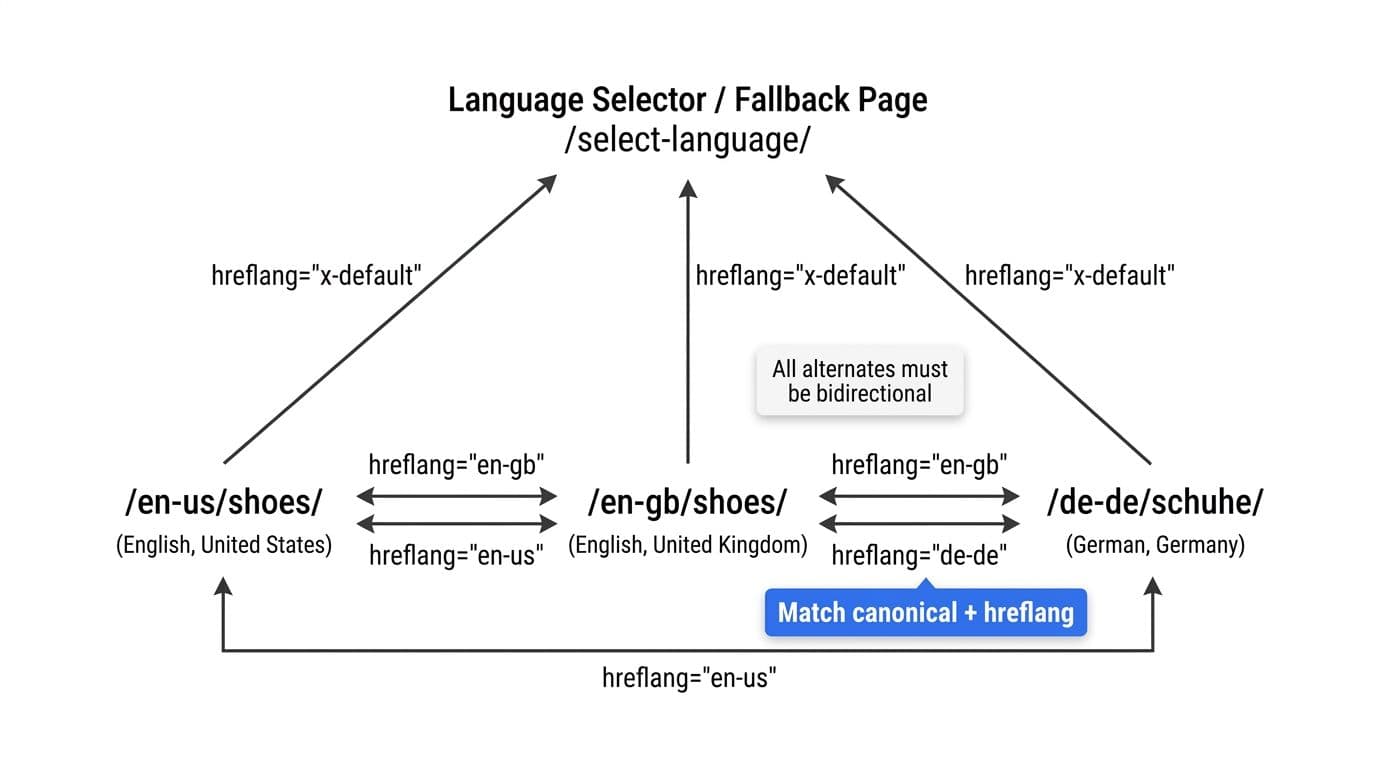
hreflang isn’t a ranking boost. It’s a routing system. When it’s correct, Google is more likely to show the best regional page in the SERP.
Pick one implementation method and stay consistent:
- HTML hreflang tags using
<link rel="alternate">in the<head>(easy per template, heavy for very large sites) - XML sitemaps with hreflang tags (often best for thousands of URLs)
- HTTP headers (rare for e-commerce pages)
HTML hreflang example (category page)
On https://example.com/en-us/shoes/, your <head> should include self-referencing and all alternates:
<link rel="canonical" href="https://example.com/en-us/shoes/" /><link rel="alternate" hreflang="en-US" href="https://example.com/en-us/shoes/" /><link rel="alternate" hreflang="en-GB" href="https://example.com/en-gb/shoes/" /><link rel="alternate" hreflang="de-DE" href="https://example.com/de-de/schuhe/" /><link rel="alternate" hreflang="x-default" href="https://example.com/language-selector/" /> (x-default tag)
Now repeat the same set on /en-gb/shoes/ and /de-de/schuhe/. These use ISO codes like en-US for US English and de-DE for German in Germany.
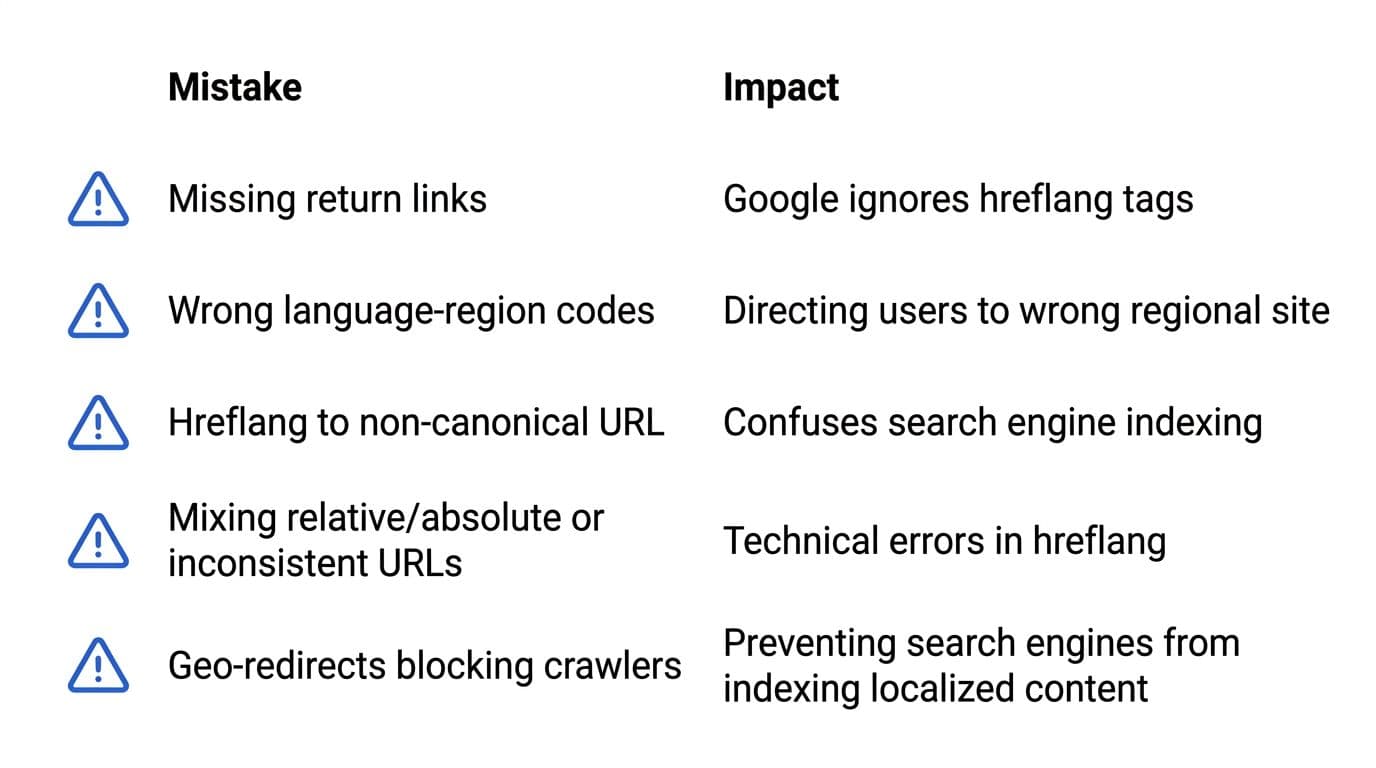
Gotcha: hreflang works in “clusters.” If one page doesn’t link back (a missing return link), Google may ignore the whole cluster.
If you want a deeper walkthrough of hreflang placement options and failure modes, see this international SEO hreflang guide.
XML sitemap hreflang example (better for thousands of URLs)
For large catalogs, generate hreflang in your sitemap from your product and category mappings (SKU or category ID). Here’s a realistic single-URL entry:
<url><loc>https://example.com/en-us/shoes/</loc><xhtml:link rel="alternate" hreflang="en-US" href="https://example.com/en-us/shoes/" /><xhtml:link rel="alternate" hreflang="en-GB" href="https://example.com/en-gb/shoes/" /><xhtml:link rel="alternate" hreflang="de-DE" href="https://example.com/de-de/schuhe/" /><xhtml:link rel="alternate" hreflang="x-default" href="https://example.com/language-selector/" /></url>
Make sure your sitemap header includes the XHTML namespace (often missed):
xmlns:xhtml="http://www.w3.org/1999/xhtml"
Localized category page templates that rank and convert
A localized category page delivering effective localized content shouldn’t be a swapped language string file. It’s closer to a store aisle built for local shoppers: same core products, but different signage and priorities.
Use a template that separates translation (language) from localization (market fit considering cultural nuances). This keeps the system scalable when you add five more countries.
Here’s a practical pattern for category pages:
| Category element | Translate | Localize |
|---|---|---|
| Page metadata (titles, descriptions) | Yes | Yes (optimized for each locale) |
| Category name (H1) | Yes | Sometimes (local phrasing) |
| Intro copy above products | Yes | Yes (seasonality, use cases) |
| Facet labels (color, size) | Yes | Yes (units, sizing systems) |
| Product grid | No (data-driven) | Yes (availability, shipping limits) |
| Sort options | Yes | Sometimes (local preferences) |
| Buying guides, FAQs | Yes | Yes (regulations, returns) |
| Internal links to subcategories | Yes | Yes (local best-sellers) |
Template recommendation: keep the URL slug stable per locale, but don’t force exact word-for-word alignment. Include elements like a currency switcher for better conversion. For example, /de-de/schuhe/ can map to the same category ID as /en-us/shoes/. Your CMS should store a shared category entity, with localized fields layered on top.
Also, watch your “helpful” automation. If you auto-generate 300 words of category text for every locale, you’ll create thin, repetitive localized content fast.
Faceted navigation and duplicate content: do and don’t rules
Facets multiply URLs, and international adds another multiplier. If you don’t set rules early, crawl budget disappears into filters and parameter combos, which eventually hurts your site’s organic traffic and visibility.
Faceted navigation, do:
- Pick a small set of indexable facets that match real demand (for example, “men’s running shoes” or “waterproof hiking boots”).
- Create clean landing pages for those facets (static URLs or controlled rewrites), with unique localized content that improves user experience over messy parameter URLs.
- Canonicalize noisy parameter URLs back to the closest clean category or facet landing page.
Faceted navigation, don’t:
- Don’t let every parameter combination become indexable by default.
- Don’t hreflang every filter URL unless it’s a real landing page in each market.
Duplicate content, do:
- Keep canonicals within the same locale in most cases (US canonicals should usually point to US URLs).
- Standardize URL formatting (trailing slash, lowercase, consistent query parameter order).
Duplicate content, don’t:
- Don’t point canonicals from regional pages to a single global page “to consolidate.” You’ll break regional indexing.
- Don’t geo-redirect bots based on IP with forced redirects. It can block crawling and indexing.
For additional examples of real-world mistakes teams make during rollouts, this breakdown of international SEO common mistakes is worth scanning.
Troubleshooting: when the wrong region shows in SERPs
Use this table when issues pop up after launch or migration.
| Symptom | Likely cause | Fast check | Fix |
|---|---|---|---|
| UK page ranks in US results | Missing en-US alternate, or wrong canonical | View source, compare canonical + hreflang | Add full hreflang tags cluster, correct canonicals |
| hreflang set, but Google ignores it | Missing return links, or mixed URL formats | Check Google Search Console for hreflang errors; validate one full cluster across 3 pages | Ensure bidirectional links, use consistent absolute URLs |
| German pages indexed, but not category pages | Category template lacks hreflang, products have it | Spot-check category <head> or sitemap | Add hreflang at category template level |
| Correct pages exist, but users get redirected | IP redirects firing before page loads | Test with a crawler user-agent | Use a banner or selector, allow access to all locales |
| Many duplicate URLs indexed per locale | Facets and parameters indexable | Check indexed parameter patterns | Canonical rules, restrict indexable facets, tidy internal links |
When in doubt, reduce variables, check loading speed to ensure regional performance is not the cause of poor ranking, then fix one category cluster end-to-end and scale the same logic across templates and feeds.
Pre-launch checklist for international e-commerce SEO
Before you expand to the next country, run this quick pass:
- Confirm one URL strategy (subfolder, subdomain, or ccTLD) and stick to it.
- Make hreflang complete and bidirectional for categories and products.
- Add
x-defaultto a real selector or global page that doesn’t redirect by IP. - Ensure each locale’s canonical points to the correct locale URL.
- Block or canonicalize non-value facet parameters; keep only intentional landing pages indexable.
- Verify mobile optimization and Core Web Vitals performance across all locales.
- Localize category intros, FAQs, and filters, not just product titles.
- Make internal links prefer the user’s locale (header, footer, breadcrumbs).
- Verify localized currency, sizing, shipping limits, and returns content.
- Submit locale-specific sitemaps; set up Google Analytics to monitor performance per locale.
- Check visibility on local search engines (such as Baidu or Yandex) for specific regions.
- Build backlinks through digital PR to boost local authority in new markets.
- Spot-check templates after every release, because one theme change can remove hreflang.
International growth doesn’t need to be messy. With a scalable template, strict URL rules, clean hreflang tags, and proper clusters, international seo ecommerce becomes repeatable instead of fragile. For international SEO ecommerce, the best test is simple: when a shopper searches locally, do they land on the page that feels like it was made for them?